Emma Cocker is a writer-artist and Associate Professor in Fine Art at Nottingham Trent University, UK. Her research enquiry unfolds at the threshold between writing/art, involving diverse process-oriented, dialogic-collaborative and aesthetic-poetic approaches to working with and through language. Cocker often works in collaboration with other artists on durational projects, where the studio-gallery or site-specific context is approached as a live laboratory for shared artistic research. Cocker’s writing has been published in Failure, 2010; Stillness in a Mobile World, 2010; Drawing a Hypothesis: Figures of Thought, 2011; Hyperdrawing: Beyond the Lines of Contemporary Art, 2012; On Not Knowing: How Artists Think, 2013; Choreo-graphic Figures: Deviations from the Line, 2017; The Creative Critic: Writing as/about Practice, 2018; Live Coding: A User's Manual, 2023, and in the solo collections, The Yes of the No, 2016, and How Do You Do?, 2025. Cocker is co-founder of the international Society for Artistic Research Special Interest Group for Language-based Artistic Research. See also https://orcid.org/0000-0002-2985-7839

New Work: Live Writing (Feeling it for You)


“The essence of language is to be articulated. Such articulations can be as smooth as one wishes; they are no less divisive for all that. In order to language to function, signs must be isolable one from the other (otherwise they would not be repeatable), At every level (phonetic, semantic, syntactic, and so on) language has its own laws of combination and continuity, but its primary material is constructed of irreducible atoms (phonemes for spoken language, and for written, signs whose nature varies according to the system in question: in alphabetic writing, for example, the distinctive unit is the letter). Whoever says ‘articulation’ always says, in the final instance, ‘divisible into minimal units’: the articulus is the particle. Language is the hierarchical combination of bits. Liquid, on the contrary … is indivisible” Yve Alain Bois, 'Liquid Words', in Formless: A Users Guide, p124.


Tests from a series of new ‘Live Writings’ generated from my experience as ‘Seer-in-Residence’ (see posts below). Live Writing  (working title) is a new method of producing writing that I am currently playing with, provoked specifically through my experience as a Seer-in-Residence. Still very much a working approach at present, my intent is to explore the possibility of a form of live writing operating at the nascent point of words coming into being before collapsing, where language appears somehow reluctant to become solidified into coherent sentences or legible meaning.


As with the Close Readings, I am considering how strategies of skimming and the visual encounter with words 'close up' produces other kinds of meaning, where words are not always distinguishable as discrete signifying units, but instead appear liquid, their sense blurred. I am thinking about the possibility of a language for reflecting the not-quite-seen or captured, for reflecting the sense of the glimpsed. Visually, the live writings perhaps point to these moments of blindness within perception, to ellipses and eclipses within witnessing, rendered as a not-yet of language punctured through with gaps and holes. 

Emma Cocker, Live Writing (Feeling it for You)

Presented as a poem or even score of sorts, the live writings perhaps also intimate towards the possibility of reading or vocalisation. Blindness becomes breathlessness; the not being-able-to-fully-grasp of language articulated through syncopated speech-acts, assemblages of plosive phonemes and vowel sounds, of hyperventilations and gasps.  

My experience of the Seers-in-Residence project has also provoked me to think a little more about the relation  between eclipses and ellipsis, which I now hope to develop further through new visual/textual work (for example see test below) and new writing. Both eclipses and ellipsis indicate towards an obscuring, something hidden from view. Ékleipsis — an ancient Greek word referring to a state of abandonment or downfall, the ceasing of something to exist. Élleipsis — an omission. Falling short … the dot dot dot that marks the space of awkward silence or of momentary pausing, the removal of extraneous detail, the dissipation of unfinished thought.

Emma Cocker, Eclipsing Ellipsis, 2013


New work: Close Reading (Feeling it for You)


Tests from a series of new ‘Close Readings’ generated from my experience as ‘Seer-in-Residence’ (see posts below). The texts encountered during my residency included: Roland Barthes, ‘The Metaphor of the Eye’, from Georges Bataille, The Story of Eye; Catherine Clémente, ‘Syncope’s Strategies, from Syncope: The Philosophy of Rapture; Hélène Cixous, ‘Writing Blind’, from Stigmata: Escaping Texts; Luce Irigaray, ‘To perceive the invisible in you’, from To Be Two. The second 'close reading' draws on a sentence from Cixous' Writing Blind, "Answer: the text needs the paper. It is in the contact with the sheet of paper that sentences emerge", which seems especially pertinent to the concerns of my Close Readings.
 
Emma Cocker, Close Reading, (L.I.T.B.T)

Emma Cocker, Close Reading, (H.C.W.B)

Event: Close Reading/Live Writing (fragments)


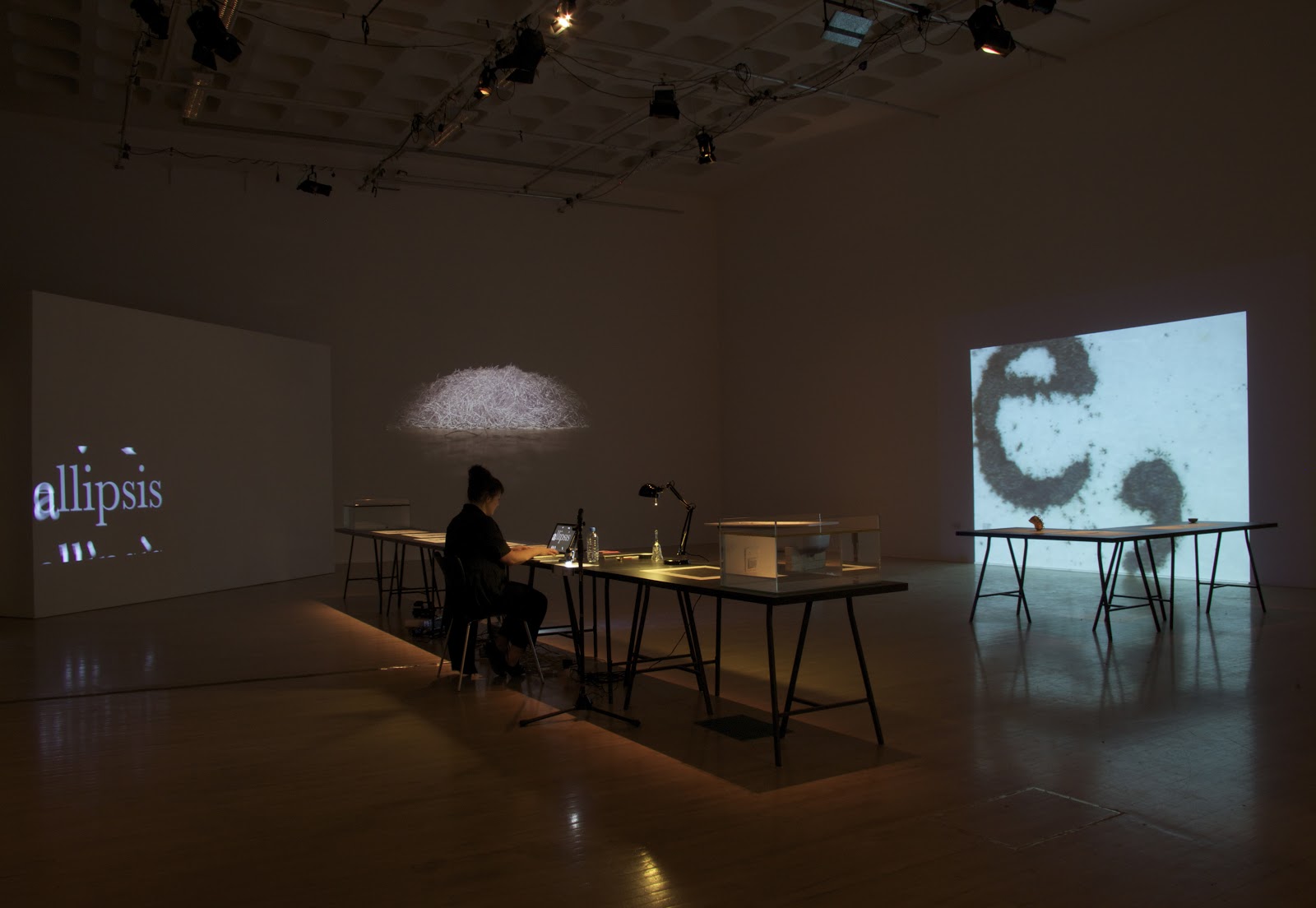
Further documentation from my Close Reading/Live Writing, undertaken as a ‘Seer-in-Residence’at Bonington Gallery, Nottingham in conjunction with the exhibition From Where I Stand I Can See You by Traci Kelly and Rita Marhaug.  Photography by Julian Hughes.

Event: Close Reading / Live Writing


Emma Cocker, Close Reading/Live Writing, undertaken as a ‘Seer-in-Residence’.

On Thursday 10 January I undertook a ‘micro-residency’ as a ‘Seer-in-Residence’ at Bonington Gallery, Nottingham in conjunction with the exhibition From Where I Stand I Can See You by Traci Kelly and Rita Marhaug. Along with 3 other researchers (including Jo Lee and Ben Judd who will be "seers" in the coming weeks), I was invited by Traci Kelly to spend time interacting with the exhibition in a way that evokes my own practice and research interests. 

Emma Cocker, Close Reading/Live Writing, undertaken as a ‘Seer-in-Residence’.

I approached the ‘residency’ through the prism of my ongoing Close Readings project. Amongst other things, I performed a ‘close reading’ of Kelly’s work Feeling It For You (Perspective), alongside fragments from a number of texts that seemed to resonate with some of the concerns of the exhibition (listed below), applying close visual attention to both text and image using a microscopic camera (as a live/performative action which will subsequently result in video/text-based work). The texts included: Roland Barthes, ‘The Metaphor of the Eye’, from Georges Bataille, The Story of Eye; Catherine Clémente, ‘Syncope’s Strategies, from Syncope: The Philosophy of Rapture; Hélène Cixous, ‘Writing Blind’, from Stigmata: Escaping Texts; Luce Irigaray, ‘To perceive the invisible in you’, from To Be Two.

Emma Cocker, Close Reading/Live Writing, undertaken as a ‘Seer-in-Residence’.

Whilst the Close Reading series is ongoing, this was a first attempt at staging the process as a live event, which I hope to now develop further within other contexts. The 'Seer-in-Residence' invitation has also enabled me to develop a form of Live Writing (even Live Notation perhaps?) in which live reflections are compiled (see the left-hand screen) and then animated through the repeated scrolling and skimming of the text. Extending from the 'Seer-in-Residence' experience, I hope to develop a video or possible text-work from the Live Writing component, alongside new writing exploring ideas around eclipses, ellipses and ellipsis, and the relationship between ‘seeing’ and ‘reading’. The event was also documented by Julian Hughes, whose photographs will help to reflect the various methods/processes explored during the Seers-in-Residence project within a forthcoming publication.


Writing: Stepping Towards Stepping Away


Below is my introductory text produced as part of the 'Seer-in-Residence' project linked to the collaborative exhibition, From Where I Stand I can See You by Traci Kelly and Rita Marhaug, opening this week at Bonington Gallery, Nottingham. Along with 3 colleagues, I have been invited to be a 'Seer-in-Residence', interacting specifically with Kelly's work Feeling it For You (Perspective) through the prism of my own practice and research interests. The results of the 'Seer-in-Residence' project will be published later in 2013.

Stepping Towards Stepping Away

(W)e can each become, the one for the other, a bridge towards a becoming which is yours, mine, and ours. I can be a bridge for you, as you can be one for me. This bridge can never become the property of either … I perceive you, I create an idea for you, I preserve you in my memory in affect, in thought in order to assist your becoming. While I become me, I remember you. This should be a double gesture: you should be a bridge for me, as I should be one for you. Without a doubt, these bridges are not the same. [1]

Within a research culture that often privileges the distinction of one’s research from others, what place is there for the building of bridges? Beyond the realm of institutional collaboration and network bids, what does it really mean to construct spaces for speculation, for sharing ideas, for thinking together? How might I become a bridge for you, as you can be one for me? The construction of bridges attests to the desire for connection, facilitating movement and communication between one place or person and another. A bridge is used to join territories, opening opportunities for further dialogue and exchange. Building bridges can overcome obstacles that might otherwise divide and isolate, by creating passageway over rivers and chasms, or by crossing the line of difference that separates here from there, then from now, you from me, the familiar from the as-yet-unknown. A bridge might begin with an invitation, an initial reaching towards the other. Towards reciprocity I approach you through the prism of my own practice; in turn, my practice is approached through the prism of yours. Yet, there are inherent risks to bridge building proposals can collapse before they ever get off the ground; rejection too, for there will always be those who prefer to remain an island. The bridge contains both threat and promise, for it involves a challenge to one’s habitual limits, it requires one’s borders are rendered open, porous. A bridge must be built in good faith neither in fear of trespass or invasion from the other, nor based on a will to territorialize and control. The bridge is the space where true collaborations are founded, never fully owned by either side. Not just for crossing or passage, the bridge itself can be inhabited as a working zone, a state of temporary suspension that refuses to be bound by the binary logic of either ‘this’ or ‘that’. Franchissement a French term meaning both crossing and clearing. Bridge always both and between, always inter. The bridge is akin to the space of artistic research: between production and reflection, between art world and academia, between […] Between ignorance and knowledge, Sarat Maharaj locates the Sanskrit term avidya or ‘non-knowledge’. Avidya is not the opposite of vidya (knowledge or ‘to see-know’) but rather the prefix a signals towards neutrality, the suspension of binary terms. [2] For Maharaj, ‘Avidya is more about production, about generating new forms of think-feel-know, about first-person creativity, unknown circuits of consciousness … an unscripted condition where anything might happen’.[3] To step onto a bridge is to abandon something of the terra firma of solid ground, as a step towards the other is a step away from oneself, one’s comfort zone. A bridge can lead first in the direction of open water before it reaches the far shore. Dépaysement a French term meaning to be taken out of one’s element, led astray. [4] A vertiginous pleasure can be experienced in stepping off, into the brink, away from what is known or certain. A bridge is not always constructed for the purposes of getting to the other side. There are certain perspectives that can be encountered only by inhabiting the points between, by relinquishing fixed positions, through loss of stable ground.


[1] Luce Irigaray, ‘To perceive the invisible in you’, in To Be Two, (The Athlone Press: London and New Brunswick, 2000), p.43.
[2]  Maharaj gives examples of the neutral prefix a including ‘typical - atypical - untypical’ and ‘moral - amoral - immoral’. See Maharaj, in Sarat Maharaj and Francisco Varela, ‘Ahamkara: Particules élémentaires of first-person consciousness’, in Intellectual Birdhouse: Artistic Practice as Research, (Koenig Books, 2012), p.73.
[3] Maharaj, 2012, p.73.
[4] Alternatively, Michel Foucault uses the term égarement to mean ‘straying afield from oneself’, as noted by Paul Rabinow in Michel Foucault, Ethics: Essential Works of Foucault 1954 — 1984, Vol. 1 Subjectivity and Truth, (ed.) (The New Press, 1997), p.xxxix.