emma cocker
Sheffield, United Kingdom
Operating under the title ‘Not Yet There’, my practice is characterised by a mode of restlessness - or wandering - that functions as both the subject of and motivation for my enquiries. Writing/text-based work (often developed dialogically through conversations with other artists) interrogates the critical and creative potential within experiences or conditions such as failure, doubt, deferral, uncertainty, boredom, hesitation, indecision, immobility & inconsistency, by exploring models of practice - and subjectivity - which resist or refuse the pressure of a single or stable position by remaining willfully unresolved. I am interested in exploring the 'thinking space' of practice by shifting attention from the notion of the 'deliberate' towards the process of 'deliberation'; by insisting that purpose or meaning is not synonymous with the notion of achieving a ‘goal’. I am currently working on the forthcoming publication, Desiring to be Led Astray: The Art of Wandering'. I am a Senior Lecturer in Fine Art at Nottingham Trent University. For other strands of my practice see crosscurrentssitesofexchange.blogspot.com and emma-cocker.blogspot.com
View my complete profile

Sunday, 7 June 2009

The Summer of Dissent

I will be producing a new piece of critical writing in response to the proposed Summer of Dissent at Plan 9. The Summer of Dissent brings together a range of practioners seeking to dismantle and reassemble cultural norms through collective action and singular acts of sedition. Events reflect concerns around physical and mental survival - ranging from The Keepers, a mapping project that seeks to preserve and build knowledge of urban wild food, to The Coming Insurrection, a discussion around freedom of speech and textual terrorism. By collectively scrutinising the current geo-political situation through the prism of cultural production these events invite the audience to view, collaborate and question. 


Image: Ali Jones, Everybody Move

The programme at both Plan 9 and off-site venues, includes the enactment of Guy Debords' Game of War by Rod Dickinson & Class Wargames; a psychic meeting calling for an Art Strike by the Second Temporary Art Strike Action Committee (Alytus Chapter); weapon making with Girl Gang; research into insanity by the collective Alialani; and a public swim protest with Kayle Brandon and Heath Bunting. 

A publication will also be produced to document Summer of Dissent with a commissioned text 
by Emma Cocker and a specially produced flyposter from Laura Oldfield Ford.

More information can be found here.

Thursday, 4 June 2009

(UN)Folding Zagreb

I am going to be participating in this research-creation workshop as a way of developing and extending some of the performance ideas developed in collaboration with Open City. I am in the process of developing further research – entitled Between Wandering and Waiting – which continues to investigate the creative and critical value of strategies such as wandering, waiting and performed stillness within an artistic practice, by asking how they might contribute towards the production of pragmatic models (‘tactics’) for interrogating contemporary forms of subjectivity. As part of this research I am in the process of developing critical connections with other artists, performers and theorists interested in similar concerns. Whilst my practice is primarily theoretical/writerly I am interested in opportunities through which to (tentatively) test out some of these ideas through practice.

(UN)Folding Zagreb is a three-day collaborative workshop that will take place during PSi15 directed by Sara Wookey, Bianca Scliar Mancini and Christopher Brunner

In a format that resembles a workshop but that aims at a collective research-creation process participants will use movement and rhythm as techniques to explore how to know Zagreb through affects. Participants will share a short reading pack, which includes philosophical texts, as well as other relevant writings and images that will set a common ground of knowledge about the city.

With three molecules of actions, each one with a specific focus on either movement, visual or sound elements, this method of approaching the city is strongly based on improvisation techniques, both from dance and music, which priories flow and process; it is anti-flaneur as it proposes participation and movement of the body as a tool for engagement with the others in the space of the city, exploring the notion of gestural contamination.

(Un)Folding Zagreb consists of intense work during the three blocks of three hours of  activities in the studio (physical propositions), outdoors (tasks of collecting) and on mapping techniques ( collective composition). 

Tuesday, 21 April 2009

No Longer and Not Yet

The text below has been written for this year's NTU degree show catalogue.

"The conclusion is the event whose occurrence brings about the end; it is a point of resolution that draws the experimentation to a close. An answer has been found, a result gleaned, a decision made. Conclusions often rest upon the production of something definitive, something certain. They describe the final chapter of the thesis, which attempts to draw together the loose ends, to smooth out or reconcile the differences or inconsistencies within an argument or investigation. Here, the indeterminate or unruly meanderings of an enquiry become dutifully reined in or stilled, where the restless activity of a thinking process is required to steady itself, to fix upon its goal. Conclusions can terminate the trajectory of a given episode of time or line of narrative – they are the final scene; the end of an era, the protagonist’s last breath. However, within art practice conclusions are rarely definitive or final, but rather present as provocation for future action or as moments of pause within a never-ending permutational chain of possibilities. Enquiries become shaped into one form, before being collapsed back once again for the process to begin afresh. The fine art degree show itself should be seen in such terms – less a marker of closure as an opening out into the space of the future. It is a double-headed arrow – pointing back towards the creative labour of production and of thinking, and forward as a promise of what might still be to come. It signals and celebrates the results of an imaginative process that has already taken place but significantly is also charged with potential.


Strictly speaking, the degree show is not an ending at all, rather a space of transition, of new beginnings. It is the visual manifestation of a rite of passage according to whose terms art students exit the realm and restrictions of the university to navigate their way into the world beyond. The duration of the degree show is a zone of expectant limbo. We are between times no longer and not yet. However, this rite of passage is not just about the initiate (student) increasing their status on the hierarchical ladder of social standing, of graduating into the employment ranks of the ‘with honours’. Rather, an (art) education has the capacity to function in more critical terms. For social anthropologist Victor Turner, universities should be understood as ‘liminoid’ settings or as an ‘antistructure’ capable of generating alternative ways of being and thinking to the mainstream or habitual. Whilst the liminal experience often reinforces and works with existing social hierarchies, Turner argues that, “liminoid phenomena … are often parts of social critiques or even revolutionary manifestos … exposing the injustices, inefficiencies, and immoralities of the mainstream economic and political structure.”[i] Rather than being easily unquestionably assimilated back into the existing social order then, the critical subject produced through the liminoid experience has the capacity to conceive of things differently or invite change they have a transformative potential. It is this questioning potential that a fine art course hopes to nurture. Undoubtedly, there will be those for whom the degree show will function as the final conclusion to their practice, indeed those for whom the art degree itself is valued only for its transferable properties in an ever competitive job market. However, perhaps there will also be others for whom the experience will continue to function as a provocation or as the catalyst to go out and make things (differently)."


[i] Victor Turner, From Ritual to Theatre, The Human Seriousness of Play, (PAJ Publications, New York, 1982), pp.54-55

Friday, 17 April 2009

(not) new work

I am currently developing ideas for the publication which is being produced through collaboration with other art-writers/artists as part of the Critical Communities project.

Re: Writing
Abstract:
In the process of writing about other things I have noticed that there are often these embedded fragments, half sentences and curious revelations that seem to simultaneously describe or equate to the act of writing itself, and the struggle therein. I want to use the publication as an opportunity to produce a piece of writing that is perhaps approaching an idea of practice. I am interested in recycling or reusing text fragments from existing work. I want to return to earlier writing and rescue fragments that had perhaps seemed incidental or unremarkable and collate them as a litany of reflections on writing, on writing as a practice. I am interested in the way that this format will ultimately allow me to bring fragments of ‘academic’ writing into proximity with material that is rather more personal, doubtful or which has hitherto remained hidden. I want to find a way of introducing a sense of inconsistency or contradiction or a feeling of moving between critical, philosophical or even theoretically (sounding) fragments and those which speak much more about a feeling of a love affair with the process of writing, or of the inevitable experience of failure or inability or inadequacy encountered in the process of trying to write about art practice. It is a rule based piece I suppose – the rule being (not new work) or (nothing new). I suppose the other rule I am considering is in terms of the length of the text – which is going to use the 'rule' inherent within the brief which is to produce a piece of writing with an upper limit of ‘2000 words’.

(sample excerpt below)

Re: Writing

(1) I am not sure how to begin; (2) It is certainly taking the shape of words; (3) However this is subject to revision; (4) Categories quiver at the point of collapse; (5) Trying to produce some other way of adequately describing the experience; (6) I am hesitant in speaking the words out loud; (7) Without due care things might spiral out of control; (8) She begins. The pages tremble; (9) Subject position is cast adrift; (10) Words unfurl, not knowing how they got there; (11) Uneven and discontinuous; (12) Always out of reach; (13) Full of holes; (14) A tender documentary residue; (15) Not so much a beginning then as a suture; (16) It is a liquid state or heavy like an industrial accident; (17) In which the seams remain critically visible; (18) Unassuming moments when nothing happens; (19) Breaks things down but also leaves them open; (20) Bringing into crisis, intensively, with care; (21) Within the limited constraints of a given language; (22) Things remain insensible or nameless; (23) I won’t play by their rules; (24) Pushing at the edges of one meaning whilst holding back the terms of another; (25) Worried until they begin to recombine differently; (26) In a more contingent, disruptive manner; (27) Complicate the possibility of arriving at a single answer; (28) But rather to conceive of new names; (29) By reassembling its languages into counter-narratives; (30) Always happening in the present; (31) It is impossible to ever exactly duplicate an action; (32 The discrepancy between what is visible and what is not; (33) I feel something; (34) Flutter-flutter; (35) Wanting more; (36) To feel its letters over my tongue; (37) I try to take it all in at once; (38) It is in these things that I remember; (39) I have not forgotten; (40) A graft of something already existing; (41) Meaning to try, a tentative attempt; (42) As an echo or vibration drawn and performed through the body; (43) Clandestine love affairs with another’s thoughts; (44) Once uttered they become rather hard to delete or forget; (45) Each bringing the other into being; (46) Silences that mark unexpected endings; (47) Ideas buried beneath the surface; (48) They seem to resist forming words; (49) Instead bleed across one another; (50) Contiguity is only ever a form of being in contact with; (51) Rather than unnecessary interference at its periphery; (52) Both a spatial form and a temporal event; (53) A pivot about which things turn; (54) Proposing tangents to be – both literally and literarily – followed; (55) Haunted by memories of earlier inhabitations; (56) Whether this thought can be mine alone; (57) A memorial to those unspoken; (58) By one’s own volition; (59) Like the nagging of an obsessive’s itch; (60) Intellectual holes that may well be revealed in time; (61) I feel duly torn in two; (62) Not wholly knowing how to respond; (63) It is not that easy; (64) Something has been left unsaid; (65) Sometimes a foil is needed through which to conjure reflection; (66) Language can be irredeemably imprecise; (67) In a language that cannot be read; (68) Only infrequently captures the experience of the moment; (69) I am letting you in; (70) As a process for producing tangential experiences; (71) I am willing it to happen soon; (72) An intuition for knowing when to yield; (73) Touching upon; (74) There can only be so many ways of saying the same thing; (75) Yet there is an inherent incompleteness in the task at hand; (76) Dialogue broken, a sentence stalled; (77) A speechless mode of incommunicable proximity; (78) A mode of attendance or attention; (79) The prospect of hearing me on your lips; (80) As closely as possible; (81) Logic might become frayed; (82) Thoughts well in my head, heavy and meaningless; (83) A kind of restlessness; (128) I have had such thoughts before; (84) Being struck by something; (85) In case of an emergency to let in breath; (86) A desire to avoid the temptation to simply repeat; (87) Making blind leaps into darkness; (88) Stammering in the path of understanding’s procedural flight; (89) Resilient sites of criticality; (90) That emerge simultaneously; (91) An action is required; (92) Proximity to the work does not guarantee any certainty or assuredness; (93) Conditions; (94) Refusing to play by the terms of existing power relations; (1) The cycle of iteration begins again once more; (95) The notion of the telos is often rejected or sabotaged; (96) Beyond words as such; (97) Without obligation; (98) The continual reconfiguration of the rules of engagement; (99) Between producing illumination and further opacity; (100) Before other meanings have begun to fully form

As part of the project we have responded to the abstract's of each other ... here is an excerpt from the response to my work from Nathan Walker :

"Into Suspension. Re guarding. Guarding. Taking all that stuff and re-cognising it. Because there is so much writing in the world the job is not to make more but to construct new texts out of the ones that already exist. This is working clever. Emma is removing the specificity and allowing for a kind of openness. In context. Emma is not producing academic writing. This is practice. This material is different material. Like instead of a new quilt we have a patchwork. Instead of starting again Emma is sifting, dealing (like we deal with cards) with the writing stuff. Emma is interested in plagiarism. The thief. Les Voleurs. Stealing your own work and writing into it. Saying things without knowing what your saying. Arrows. Indexically. Storage space. Holding space. Writing about one thing and it really is writing about an other thing. The stuff behind the words. The reclamation of recycled materials that perform the space of writing. This is about the process of writing itself. The struggle within the labor of practice. The hesitation, the deliberation of practice. The fragile moments of writing. Foil the goal. No goal. Own Goal. Re-Writing. Re(ally)Writing"

Monday, 6 April 2009

Still

I have been invited to extend my essay 'From Passivity to Potentiality: The Communitas of Stillness' into a longer text, as part of a book proposal being made to the Routledge International Library of Sociology series. More to follow soon.

Wednesday, 1 April 2009

Inconsistency as strategy

Here is an outline of my revised conference paper to be delivered as part of the 35th AAH Conference "Intersections", at Manchester Metropolitan University, Manchester, 2 - 4 April 2009 (original abstract and context for the paper can be found here). Extracts from the paper and an interview (with Ben Judd) undertaken as part of the research can be found on Ben Judd's website under Interviews and Texts.


Image: Ben Judd, The Symbol, 2009

This paper explores how the seemingly undesirable presence of ‘inconsistency’ can function within artistic practice as a way to strategically resist, refuse or even attempt to revoke the societal pressure to perform in a consistent manner or from a single, stable position - according to expectation, convention or the norm [...] Arguably, the interrogation of inconsistency requires that certain conceptualizations of both subjectivity and knowledge to be brought into question or challenged – it is a term of ethical and epistemological import. What is at stake in thinking through the terms of inconsistency, perhaps, is the question of what it might mean to be, and in turn how this contingent (inconsistent) experience becomes subjected - even subjugated - to various forms of translation, definition or homogenous representation. Inconsistency, in this sense, is not only a necessary part of practice and thinking - which perhaps disappears as things approach resolution - but can also be deployed strategically as a way of subverting, challenging or resisting the ‘pressure of consistency’ or of conformity, of expectation or of homogeneity. My attempt then is to propose a critical function for inconsistency where it shifts from meaning a mode of dithering or incoherence (a deficiency on the part of the individual) towards a mode of agnosticism or questioning that deliberately reveals the impossibility (or illusionary nature) of singular and stable positions (and which in turn points towards the deficiency of various systems of belief, classification or representation). Here, agnosticism is put forward as a critical form of uncertainty, the doubt that a particular question or problem has a single correct answer or that a complete understanding of something can be attained. Here, agnosticism is a mode for addressing the experience or perhaps even the problem of being human, by insisting on the inadequacy of any single or consistent model of its representation.

My encounters with various artists (including Ben Judd, Vlatka Horvat, Dutton + Swindells) have enabled an understanding of inconsistency to develop where it shifts from a mode of refusal (of a binary logic or of the tyranny of consistency) to one of possibility (a form of affirming multiplicity and productive heterogeneity). In this paper, I want to indicate four (overlapping) models of inconsistency emerging within specific artists’ practice – inconsistency as shimmer (being both, remaining in between); inconsistency as the flagging of possibilities; inconsistency as impasse or obstacle (as an aporetic stammer); and inconsistency as rupture (the emergence of the unexpected). In each model of inconsistency, the underlying struggle perhaps is to question or refuse the dominant pressure towards consistency or homogenization especially in relation to the experience of self and its subsequent representation. Inconsistency is a way of resisting or rejecting consistency as the desirable paradigm, a device or tactic for thwarting the easy assimilation of complex human experiences into a single or stable position. It reveals the inadequacy or fallacy of existing systems of classification or representation, whilst simultaneously attempting to rupture such systems in the pursuit of something new. Inconsistency describes a mode of restlessness, of being critical of or frustrated with existing options; of relentlessly searching for or trying to produce some other way of adequately describing the experience of being"

Saturday, 7 March 2009

Mobility and Creativity

My paper 'From Passivity to Potentiality - the Communitas of Stillness' has been accepted as part of the conference, Mobility and Creativity: Narrative, Representation and Performance, which will take place in the Department of English, University of Surrey, UK (3 July 2009 - 4 July 2009). Keynote Speakers include: Reina Lewis (London College of Fashion), John Urry (University of Lancaster) and Ginette Verstraete (Amsterdam University)

I will be presenting a paper as part of the second panel:

Panel 1 : Postcolonial Encounters

Panel 2 :  Mobility and Aesthetics

Panel 3 : Asylum and Refugees

Panel 4: Cinema of Borders

Panel 5 : Mobile methods

Panel 6 : The invisible city

Panel 7 : Creative Dis/Locations

Panel 8 : Travel Writing

Conference information:

Mobilities has increasingly become central to the analysis of social relations in contemporary society where it often appears that ‘all the world is on the move,’ from the movement of diasporas, tourists, migrants and refugees. While the emergence of this new ‘mobility paradigm’ (Sheller and Urry, 2006; Urry 2002, 2007) originated within the social sciences, this conference focuses on how such a ‘mobility turn’ has been narrated, represented and performed within the arts and humanities. The two-day international conference aims to explore creative responses to these diverse mobilities in literature, art, film, and theatre for example. How have these complex mobilities been negotiated and critiqued through creative practice? Is creativity dependent upon mobility?

The paper will extend and develop ideas from a recent essay (of the same title) which will be published in the online journal m/c (Spring 2009).

Paper abstract.
Referring to my collaboration with the artist-led project, Open City, I will investigate the (im)mobility of stillness as a creative strategy. I will explore the potential of an active and resistant – rather than passive or acquiescent – form of stillness that can be activated strategically within a performance-based practice; in turn producing conditions in which a radically dissenting – yet affirmative – model of subjectivity might be developed. Stillness is often presented as antithetical to the velocity, mobility, speed and freedom proposed by new technologies and the various accelerated modes by which we are encouraged to engage with the world. Stillness and slowness have been deemed outmoded or anachronistic forms of mobility, as fastness and efficiency have become the privileged terms. Alternatively, stillness has been reclaimed within a resistant – or at least reactive – “counter-culture” for challenging the enforced and increased pace that we are required to perform. Rather than focusing on a model of stillness based on the attempt to ‘opt out’ of the accelerated time-zones, mobilities and narratives of contemporary capitalism – the move towards a more spiritual or meditative existence by removal or denial of contemporary societal pressures – this paper will explore the potential within forms of stillness specifically produced in and by contemporary capitalism, by reflecting on how they might be (re)inhabited as sites of critical action. With reference to the writing of Gilles Deleuze – especially in relation to Spinoza’s Ethics – I want to explore how the asignifying or affective possibilities produced by the collective performance of stillness can be understood as a mode of playful resistance to or refusal of habitual social norms; additionally producing the germinal conditions for a nascent community of experience no longer bound by existing protocol, a model of “communitas” emerging from the shared act of being still.

Sunday, 22 February 2009

At the margins of intelligibility

I have been commissioned to write an essay on the work of Dutton+Swindells for a forthcoming catalogue/publication about their practice.

"Contradictory words seem a little crazy the logic of reason, and inaudible for him who listens with readymade grids, a code prepared in advance […] One must listen … differently in order to hear an ‘other meaning’ which is constantly in the process of weaving itself, at the same time ceaselessly embracing words and yet casting them off to avoid being fixed, immobilized." Luce Irigarary


        Image: Dutton + Swindells

Synopsis

This text is underpinned by the dilemma – even my anxiety – of being asked to write about an art practice whose signature is one of incomprehensibility and contradiction. It follows an extended period of discussion with the artists, Dutton + Swindells, where my role has been one of trying to ‘make sense’ of their practice – develop an understanding or rather an apprehension of it – whilst resisting the temptation to make ‘sense’  – rationalize or explain – through the writing subsequently produced. The text itself has emerged slowly, awkwardly, as I have struggled to find words or ways to speak about a practice that is critically aligned to a certain kind of muteness. It attempts – acknowledging the paradoxical nature of the task ahead – to say without wholly saying; to speak without speaking for; to comprehend the work by recognizing the power of the incomprehensible therein. The phrase ‘beyond comprehension’ is often used pejoratively, as an expression of disbelief or frustration when something cannot be made sense of or appears to lack meaning or rationale. It is synonymous with all that is baffling, impenetrable, inscrutable, unintelligible or as clear as mud. However, there is also an archaic meaning for the term where it describes the condition of limitlessness or the state of being boundless; of something existing beyond one’s grasp, beyond capture. The incomprehensible is thus that which fails to communicate or be clearly understood at the same time as that which resists or exceeds existing definition. It is marked then by the dual possibilities of deficit and excess, refusal and promise. Dutton + Swindells play with these dual possibilities, attempting to harness the affects of the former in the hope of conjuring the latter. They make work that is tactically incomprehensible in the attempt to summon or create the conditions for an encounter with that which is beyond the terms of what is already known. How then to speak of such a practice? This text attempts to occupy the threshold between speaking and not-speaking-for, between attempting to make sense of the work, yet at the same time remaining faithful - or demonstrating fidelity - to the work’s incomprehensibility, its contradictions. My plan then is to explore the nature of the endeavour within Dutton + Swindells’ practice - its tactics, manoeuvres and operations - and largely leave the work produced to speak - or indeed remain mute – for itself, to articulate its own terms.


     Images: Dutton + Swindells

Extract from the essay ....

[...] Contradiction forces a stammering or flickering in the path of understanding’s procedural flight, blocking the possibility of smooth assimilation into an existing categorical order. It renders knowledge impotent, powerless and unable to perform. Impotency, in turn, makes things vulnerable, defenseless a little tender. Meanings flail, become flaccid and unable to hold their shape or form. Impotency, then, has a double function: it renders things formless but also produces a molten state out of which new forms might arise it breaks things down but also leaves them open. Dutton + Swindells use impotency as a strategy of disempowerment, or rather as a way of discharging or exorcising forms of power that have developed through established hierarchies of value and existing systems of belief, in order to create space within which something else might emerge. Impotency becomes the terrain upon which new forces are called into being, for that which is impotent also possesses a tremendous latent charge. It wishes intensely for a potency that it is lacking, its absence fuels a desire, a powerful longing for. Here perhaps, it is possible to gain a glimpse of a now obsolete conception of impotency, where it is defined by its lack of self-restraint, even a kind of wildness. The impotent becomes curiously libidinal, ungovernable. However, by failing to perform, impotency falls beneath the radar of what is valued by a culture driven by goal-oriented productivity and outcome-based success. That which is perceived as powerless can become a blind-spot – invisible, exempted or ignored. Impotency thus emerges as a mode of stealth.

Prevented from ever fully actualizing its desires and attaining visible power, impotency remains the ever-hopeful plane of possibility from within which fledgling forms are coaxed shimmering to the brink of being. The challenge, however, is one of preventing these nascent assemblages from being identified or assimilated all too quickly back into meaning, from becoming classified or (re)claimed swiftly by the existing encyclopedia of what is known and already named. In their work, Dutton + Swindells attempt to resist the territorializing tendency of language or rather they stymie its associative chains of relations, its forms of grammatical and classificatory bondage. Speechlessness is recuperated as a critical position, for whilst that which has no language arguably has no power, certain forms of muteness can equally be understood as an articulation of protest, as the refusal to communicate or play according to the terms of existing power – or linguistic – relations. Without dialogue there can be no negotiation, no compromise, no breach of promise made. Even the smallest child grasps the unfathomable potency of wordless refusal, a silent resistance that cannot be bargained with nor eroded by the logic of rational coercion. Wordless encounters remain wholly at the level of aura or affect – in the realm of the corporeal, a touch … animal [...]

The full essay will form part of a catalogue/book which will be published by Site Gallery later in 2009. More details to follow...


Tuesday, 17 February 2009

Classical Myth/Contemporary Art

My essay, Over and Over, Again and Again, is going to be published in the forthcoming book, Classical Myth/Contemporary Art which has secured Ashgate Press as its publisher (more information to follow soon). My essay explores various practices in relation to the myth of Sisyphus (more information here).

    Image: Vlatka Horvat - Restless

The publication contents are as follows:

I. PROLOGUE - FARAWAY, SO CLOSE: MYTHIC ORIGINS, CONTEMPORARY ART- LISA SALTZMAN
II. MYTH AS MEANING
NARCISSUS, NARCOSIS, NEUROSIS: THE VISIONS OF YAYOI KUSAMA - JODY B. CUTLER
A POETICS OF BECOMING: THE MYTHOGRAPHY OF CY TWOMBLY - CRAIG STAFF
THE POROUS SPACE OF BRACHA ETTINGER’S EURYDICES (1992-2001) - MARISA B. VIGNEAULT
DOUBLE TAKE - JENNIE HIRSH
III. MYTH AS MEDIUM
DONALD’S NUMBNESS - GRAHAM BADER
OEDIPUS, KRONOS, AND ROBERT MORRIS’ BLIND TIME - BRIAN WINKENWEDER
ICARUS RETURNED: VISUAL TESTIMONY AND THE FALLING MAN - SHARON SLIWINSKI
DEEP SHIT - ISABELLE LORING WALLACE
IV. MYTH AS METHOD
ZEUXIS’ GRAPES AND THE ORIGIN OF ART - ELIZABETH MANSFIELD
OVER AND OVER, AGAIN AND AGAIN - EMMA COCKER
PHILOMELA AS METAPHOR: SEXUALITY, PORNOGRAPHY, SEDUCTION - GIULIA LAMONI
VIDEO ART IN THE HOUSE OF HADES - SOPHIE-ISABELLE DUFOUR
V. EPILOGUE
THE SPHINX UNWINDS HER OWN SWEET SELF - JOANNA FRUEH

Between wandering and waiting


            Image: Roman Ondak, Good Feelings in Good Times

I am in the process of further developing a phase of research activity that investigates the creative and critical value of forms of non-production within artistic and performance-based practice, and which will be used as a way of refocusing some of the ideas that have been emerging over the last few years within my practice. This research area is a distillation of a number of concerns emerging within my ongoing art-writing practice, Not Yet There. This broader enquiry explores how irresolution, uncertainty, disorientation and the process of ‘getting lost’ can be discussed as strategic conditions of artistic practice, by attempting the critical recuperation/interrogation of subjectively-felt experiences such as failure, deferral, disappointment, boredom, indecision, restlessness. 

Emerging from my own practice – and the questions/struggle therein – my research explores the critical value of those moments before a decision/resolution has been reached and the points at which ‘thinking’ is activated/provoked within practice. My practice is concerned with prolonging, emphasising and honouring this space of indeterminacy or potentiality in order to investigate the specific qualities of the critical ‘thinking’ that precedes – or might indeed be different to – ‘knowledge’. My work attempts to shift attention from the deliberate (directly purposeful) to the process of deliberation (care/weighing-up) insisting that purpose or meaning might not always be synonymous with the notion of achieving a ‘goal’.

Critical Communities

I have been selected to take part in the writing-based project, Critical Communities.

Critical Communities is a dialogue, discussion and writing project that will explore and expand what it means to be critical in writing on and as new work (live and interdisciplinary art). Its purpose it to explore and discuss contemporary notions of the critical and the role of critical writing in relation to new work. The project will culminate in a print-on-demand publication, produced by the writers and artists involved in Critical Communities, to be published in 2009.

The Yorkshire Critical Community includes Rachel Lois Clapham, Emma Cocker, Amelia Crouch, Joanna Loveday, Charlotte Morgan and Nathan Walker. With special guest provocateurs Sohail Khan, Alfredo Cramerotti and Derek Horton.

The London Critical Community includes Emma Bennett, David Berridge, Chloe Dechery, Rikke Hansen, Tim Jeeves, Emma Leach, Bill Leslie, Johanna Linsley, Mary Paterson, Jim Prevett and Cally Spooner.

Together the participants represent a community of new work/writing practitioners who will meet regularly in London and Yorkshire to discuss notions of 'the critical' in relation to critical writing both on and as new work. We will be critiquing our own art/writing and that of others, examining alternate critical modes both on and off the page and collaboratively developing a publication. The community will also act as a sustained network for experimental writing/new work practitioners in the London and Yorkshire areas.

Critical Communities has been developed by Open Dialogues and New Work Network (NWN) and is supported by East Street Arts, The London Consortium and Space Studios.

Friday, 13 February 2009

The Communitas of Stillness

My essay 'From Passivity to Potentiality: The Communitas of Stillness' has been accepted in the forthcoming issue of the peer-reviewed online journal m/c. The issue is entitled. Still (more information below). The essay explores recent research with Open City on the notion of stillness and can be found here.

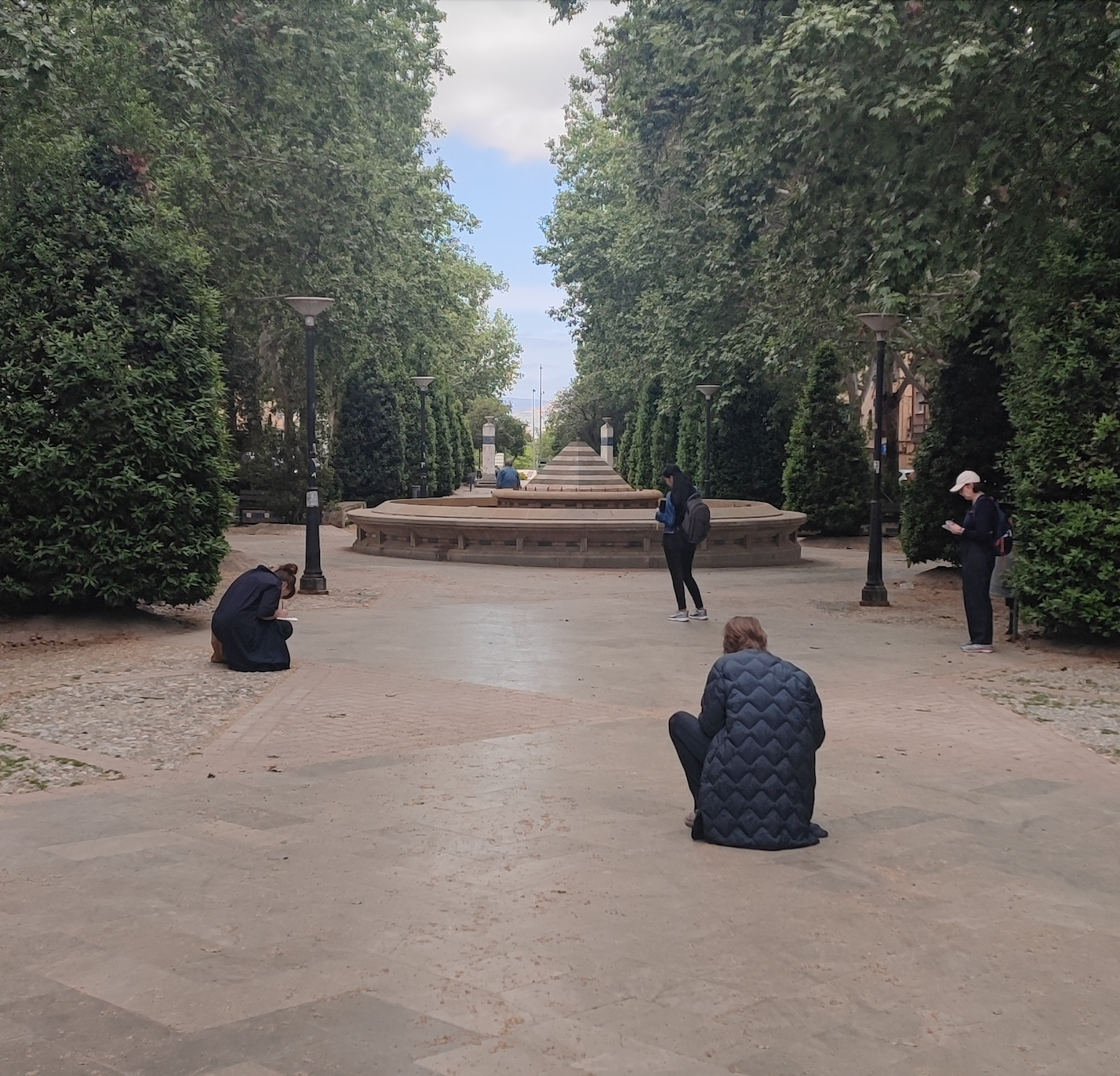
Image: documentation from Open City (Andrew Brown / Katie Doubleday), 
Radiator festival, 2009

“This paper presents the concept of stillness through the affirmative
 Spinozist lens of the ‘positive 
possibilities of life’. It expands existing research around this very
 fertile arena of 
trans-disciplinary thought by examining the affects of publicly sited 
performance […] A timely piece that 
addresses a certain mode of social engagement of vernacular life that has become a public platform
 for other activities.” Reviewers’ comments.

"For Emma Cocker, the significance of collective acts of still have the capacity to augment the affectual capacity of the body. Here, experimental practices of still in the city constitute events of resistance that disrupt habitual modalities of inhabiting the city, producing fissures within which new lines of flight can emerge. Such deliberative attunement through collective practices of still produces an affirmative model of subjectivity; a challenge to the choking assemblages of governance that stratify bodies." Editors' introduction

Abstract
Referring to my collaboration with the artist-led project, Open City, I will investigate the (im)mobility of stillness as a creative strategy. I will explore the potential of an active and resistant – rather than passive or acquiescent – form of stillness that can be activated strategically within a performance-based practice; in turn producing conditions in which a radically dissenting – yet affirmative – model of subjectivity might be developed. Stillness is often presented as antithetical to the velocity, mobility, speed and freedom proposed by new technologies and the various accelerated modes by which we are encouraged to engage with the world. Stillness and slowness have been deemed outmoded or anachronistic forms of mobility, as fastness and efficiency have become the privileged terms. Alternatively, stillness has been reclaimed within a resistant – or at least reactive – “counter-culture” for challenging the enforced and increased pace that we are required to perform. Rather than focusing on a model of stillness based on the attempt to ‘opt out’ of the accelerated time-zones, mobilities and narratives of contemporary capitalism – the move towards a more spiritual or meditative existence by removal or denial of contemporary societal pressures – this paper will explore the potential within forms of stillness specifically produced in and by contemporary capitalism, by reflecting on how they might be (re)inhabited as sites of critical action. With reference to the writing of Gilles Deleuze – especially in relation to Spinoza’s Ethics – I want to explore how the asignifying or affective possibilities produced by the collective performance of stillness can be understood as a mode of playful resistance to or refusal of habitual social norms; additionally producing the germinal conditions for a nascent community of experience no longer bound by existing protocol, a model of “communitas” emerging from the shared act of being still.

Background to the issue 'Still'
'still'
A topology of stillness haunts the space of flows. Against a backdrop of increasing research in mobilities and the mobilisation of forces of all kinds, in this issue of M/C Journal we seek submissions that attend to and reflect upon stillness. 'Still' might be many things: stillness as descriptor of a particular form of action, behaviour or disposition; stillness in an object sense; or still as in an action - to become still. This multiplicity, in turn, prompts many questions. How much effort is required to remain still or keep other bodies, things or ideas still? What might it be to think through 'still' not as a coherent and singular being-in-the-world, but something that is more fluid, diverse, fragmented and splintered? As such, what are some of the various configurations, vocabularies and politics of stillness?

Perhaps this could involve stillness as a strategy, such as to ignore or dissipate the actions of others. In the writings of idlers, or in the actions of those who refuse or cannot move into lives of permanent transit, we can see the actions of still. Here, stillness might emerge as a particular capacity in order to achieve something - where stillness becomes a productive tool rather than apprehended as a weak form of action. Alternatively, there is the still implied by delegation that comes about through trust in objects or various dispositions of delegation. Can we think about still as form of Spinozian pact, or a collective suspension? Stillness might be restorative whereby rest or being still assists with the activities of the day. Is mesmeric, dreamy stillness different from radical stillness? What about stillness that is, paradoxically, active - where it is willed, coerced or designed? What about a more passive stillness that is not willed intentionally by the body? What do these different forms of 'still' do to the body? What do they demand from the body? What are some of the bodily shapes and comportments that are associated with different forms of being or doing 'still'? And since they are not mutually discrete, how are different stills related to each other?

Still in the social sciences has often been a limited antithetical relation with life, animation and ineluctability of perpetual motion: it is the arrest of photography, or the limit of a frame. Perhaps in Walter Benjamin's phrase the 'archaic stillness' of text we see the power of stillness moving through time, but on the whole, still has enduring pejorative associations with passivity, the feminine and notions of negation. In this issue we seek to expand, recuperate and explore further stillness beyond these narrow affiliations. What does an appreciation of still do to our understanding of action and practice? As Paul Harrison claims, perhaps stillness is a necessary and 'intrinsic rather than contingent aspect of activity'. For instance, contemporary networked infrastructures produce subjectivities and ontologies in which the relation of stillness to movement is not binary or negative but fully integrated into the processes, aesthetics and politics of mobility. Stillness in all its forms is more critical in contemporary life, by virtue of and not despite, increased mobility. And yet stillness remains more or less unexplored. In this issue of M/C Journal we ask what, then, is significant about still?

Saturday, 31 January 2009

Commonwealth (The Shimmering of the Tipping Point)

Over the last few months I have been working with artist Katie Davies in conjunction with her residency at Sheffield Town Hall. On Thursday 5th February Katie will be screening her new film, Commonwealth - produced during this residency - at the Showroom Cinema, followed by a launch of the work and exhibition in the Town Hall itself.

Image: Emma Cocker in collaboration with Katie Davies, Commonwealth  (The Shimmering of the Tipping Point), plans for online video/text work.

Katie's video work in the Town Hall is accompanied by a text work which I have produced as a response to the work, as well as an essay. The text attempts to operate dialogically with the video, providing triggers through which further speculation about the work might be provoked. Following the exhibition Katie and I will be producing an online work which attempts to bring the video and text work together in order to create random moments of collision and connection between the images and writing. 

The Shimmering of the Tipping Point

1. Between the events of the past and a future way of being
2. The pivot about which things turn
3. The precarious authority of tradition
4. A gesture of tilting that sets in motion
5. Where they remain equally present
6. Others are relinquished, forgotten or are cast aside
7. A space to be treated with caution
8. However anachronistic the pledges might seem
9. A code of conduct for ensuring a smooth passage through
10. Functions to remove or limit certain rights and privileges
11. A method for managing instability
12. Assume their place within the agreed order
13. Attempts to momentarily erase or dampen the specificity of the individual
14. Become little more than empty gestures
15. The presence of latent societal values
16. No longer and not yet classified
17. Existing rules and hierarchies become reinforced and sustained
18. Where one thing suddenly slips into or becomes something else
19. The future has not yet begun
20. The continuation of common values and beliefs
21. Suspended at the point of anticipation or of preparation
22. Perpetually tuning up and ever maintaining readiness
23. Before an allegiance is pledged
24. Begin to operate within a mysterious choreography
25. The invisible boundary scoring the limits of a particular belief system
26. Remain hanging in the balance
27. A necessary part of any process of decision-making
28. The moment at which a decision is made or an opinion changed
29. As it hovers at the point of collapse
30. What it might mean to belong
31. When the mask of duty or anonymity momentarily falls
32. Laughter fluctuates between derision and affirmation
33. Any decision involves a gesture of renunciation or rejection
34. Where a group becomes frayed at the edges
35. Before a definitive choice has been made or a fixed stance taken
36. Termination of one trajectory of possibilities in favour of another
37. Narrative silently ruptures the surface of proceedings
38. The quiet reminder of what is actually at stake
39. Endeavour to support an existing order or keep things in their place
40. An inevitable period of instability and unruliness
41. They must follow the rules and offer their pledges and promises on cue
42. Without which they could lose their power
43. Simultaneously inside and outside
44. Inevitably creates that which it seeks to control
45. Not wholly knowing how to respond
46. The point at which things begin to waver
47. Devoid of specific purpose or functionality
48. What is to be gained, what forfeited or lost
49. Not experienced in the same tenor
50. Before order is returned

Living Landscapes

My paper 'Beating the ‘Invisible’ Boundary: Navigating the space in-between' has been accepted for the Aberystwyth University Living Landscapes conference, June 18 - 21, where there will be papers, presentations, performances and workshops from artists and scholars from the fields of performance, geography, archaeology, fine art, folklore studies, anthropology and literature.
Click here for more information about the conference.

Focusing on projects such as Heath Bunting’s BorderXing and Status Project, and the collaborations between Blast Theory and the Mixed Reality Research Laboratory (Nottingham), my intent is explore the critical function of the artist as both a guide or broker to the indeterminate geographies emerging between virtual and 'real' landscapes. Such practices articulate a performative crossing of physical or spatial boundaries, played out at the terrain vagues ‘betwixt or between’ the real and virtual; the visible and invisible; the physical and psychological. Making conceptual reference to the mythical figure of Hermes - god of gaps and thresholds, of boundaries and travelers who cross them – I am proposing to position the artist/wanderer as a disruptive and resistant (mis)guide to the nascent and unstable territories that are emerging between physical landscapes and digital worlds.

Wednesday, 7 January 2009

Writing Encounters within 
Performance & Pedagogy

The following paper has been accepted and will be published in a guest-edited (and peer reviewed) issue of the Journal of Writing in Creative Practice with the subtitle of writing encounters in performance and pedagogical practice. The issue is co-edited by Dr. Susan Orr and Claire Hind from the Faculty of Arts at York St. John University. It will explore writing and performance for artists, writers, critics and academics, and has been informed by the Writing Encounters Symposium which took place at York St John University 11th – 14th September 2008


“The paper is beautifully written and was a joy to read … a wonderful and articulate essay. Insightful, academic and creative, detailing a fascinating project… of very high standard and contributes significantly to the field.” Reviewers’ comments

Pay Attention to the Footnotes
Drawing on my experience of working in collaboration with the project, Open City, in this article I reflect on how this close encounter with a performance practice has enabled a critical shift within my own approach, from a mode of writing about to one of writing in dialogue with or alongside performance. Focusing on this dialogic encounter between writing and performance, I want to draw attention to a specific form of writing encounter within performance that emerged as a result of the collaboration. Open City is an investigation-led artistic project – led by Andrew Brown and Katie Doubleday - that explores how public space is conceptualised and organised by interrogating the ways in which our daily actions and behaviours are conditioned and controlled. Their research activity involves inviting, instructing or working with members of the public to create discreet interventions and performances, which put into question or destabilise habitual patterns or conventions of public behaviour. In 2007, I was invited by Open City to produce a piece of writing in response to their work for a series of publicly distributed postcards, and have since worked more collaboratively with the project on a phase of research investigating how the different temporalities within the public realm might be harnessed or activated creatively, and how movement and mobility affect the way in which place and locality are encountered or understood. In this article, I reflect on how different forms of writing – specifically the series of postcard texts - have performed in response to the work of Open City, focusing in particular on the use of footnotes and the different concepts conjured by the word. Rather than operating in their habitual role as the maligned referencing system of academia, footnotes are one of the ways in which the different temporal possibilities of writing have been explored and exploited within the project; as a creative and critical device for producing points of slowness and blockage within the act of reading, or alternatively as a form of performative invitation that encourages both textual and physical wandering by proposing tangents that demand to be – both literally and literarily - followed.

Friday, 2 January 2009

Fail and Repeat

My paper 'Fail and Repeat' has been accepted as part of the fifteenth annual Performance Studies international conference which will take place in Zagreb, Croatia, June 24-28 2009. The theme of PSi # 15 is MISPERFORMANCE: Misfiring, Misfitting, Misreading. More information about the conference can be found at http://www.psi15.com/

Image: Francis Alÿs, Caracoles

Abstract: Endless actions. Illogical quests. Misguided tasks inevitably doomed to fail or recursively performed – over and over, again and again. In diverse conceptual and post-conceptual art practices and performances, an artist appears locked into some hapless or hopeless endeavour – the repeated demonstration of a fall or failure, hide-and-seek games using the most infelicitous form of camouflage, the futile pursuit of impossible or undeclared goals. Referring to work by artists including Bas Jan Ader, Francis Alÿs and Vlatka Horvat, I want to explore a specifically Sisyphean model of failure, dysfunctionality and inoperativeness within artistic practice. I propose to move beyond an absurdist understanding of the Sisyphean paradigm towards an affirmative reading where the loop of repeated failure is actively performed as a generative or productive force, or as a mode of deliberate inefficiency through which to challenge or even refuse the pressures of dominant goal-oriented or teleological doctrines, by deferring closure or completion. Here, meaning can be seen to shift from a Beckettian articulation of futility and an individual’s resignation to the rules or restrictions of a given system, towards a form of performative resistance to and eventual displacement of the system’s authority, where its logic becomes pleasurably adopted as the rules of a game which reveal porosity and flexibility within even the most rigid framework. Sisyphean failure and repetition is thus proposed as a model of wilful non-production or open-endedness, inhabited or played out at the threshold between investment and indifference, insouciance and immersion, seriousness and levity.

Image: Francis Alÿs

Context
THEME AND RATIONALE
While we want to examine performance as a phenomenon, as experience and a function, a process, a complex and a concept, our aim is to approach it from the perspective of failure, dysfunctionality, futility, and inoperativeness. Misfiring, misfitting, misreading: it is all about the prefix. Misnaming, mistaking, misrecognition – the prefix mis- is always amiss: moreover, it is determined by what follows. There is no misnaming without naming, no misrecognition without proper recognition. Since our broad notion of performance and its possible misfires owe a great deal to Austin’s philosophy of language, rooted as it is in the paradigmatic Western metaphysical dichotomies of play vs. seriousness and success vs. failure, efficiency vs. loss, we are often forced to perceive and value cultural forms and events in terms of binary oppositions. At the same time, modernism embraced the apparently inessential, the misguiding, and the missing as leeway for a new perspective on the very constitution of new cultural systems. On the one hand, the notions mistake and infelicity are deeply embedded in modern western thought. From the Freudian slip via J. L. Austin’s misfires, the Girardian and the Derridean pharmakos/pharmakon and the Lacanian misrecognition, to Goffmanian breaches in the construction of social reality, Judith Butler’s failed gender-performances and Homi Bhabha´s inappropriate signifiers and anomalous representations, scholars have evaluated the irregular, the unforeseeable, and the unaccountable – in a word, the mistaken – as essential to rethinking the categories of what is right, correct, true, whole and serious. On the other hand, by abandoning classical ideas of universality and verisimilitude, modernist art transformed mistake into its enabling limit. From Futurist Evenings and Dada´s Cabarets to Action Theatre, Events, Happenings and Performance-Theatre; from performance art to the postdramatic concept of afformance art, performative aesthetic practices not only intentionally exposed themselves to the risk of accident, excess, and contingency, but also managed to harness their liminality as a normative – even marketable – quality.

Sunday, 21 December 2008

Ethical Possession

My article 'Ethical Possession', has been accepted by the peer reviewed journal, Scope, for a forthcoming issue focusing on ‘Cultural Borrowing’. Scope is a fully peer-reviewed online journal coordinated by the Institute of Film & Television Studies at the University of Nottingham. Scope is dedicated to publishing material of the highest scholarly interest, and work with a distinguished Editorial Advisory Board of academics and critics. For more information see http://www.scope.nottingham.ac.uk/


"This is a thoughtful consideration of the way that film and video artists borrow from, and re-present, found amateur footage and archival material; the essay provides an eloquent discussion of appropriation within contemporary art practice, anchoring its example to work by Yervant Gianikian and Angela Ricci-Lucchi." Reviewer's comments

"This is a beautifully written article that ... draws upon a range of salient critical positions – Bourriaud, Huyssen, Landsberg – to suggest a move away from the 'temporal tourism' of earlier models of appropriation (postmodern pastiche) towards more empathic models of engagement with memory, history and the archive." Reviewer's comments

"The essay is fluent, extremely well-written, and has lots of interesting things to say about art practice." Reviewer's comments

Abstract: Ethical Possession: Borrowing from the Archives
It is possible to witness a resurgence of interest in the act of cultural borrowing, in a way that is different to earlier moments of appropriation. I am interested in how this can be explored through the notion of ethical possession. The current borrowing of found amateur and archival footage within artists’ film and video can be framed as part of a wider paradigm shift, where artists and filmmakers are increasingly searching for and testing out experiential or empathetic modes of engaging with moments of the past and present. The resurgence of interest in found-film or archival material within artists’ film and video operates at a curious interstice in which a history of ideas relating to theories of production and consumption - copyright and ownership, the found object and the readymade - collides with debates around memory, amnesia and social responsibility. Referring to writing by film theorists such as Andreas Huyssen and Alison Landsberg, the aim is to explore how notions of borrowing, quotation and prosthetic experience are no longer viewed as indicative of negative pastiche or nostalgic appropriation, but are seen as re-politicized gestures through which to develop empathetic possibilities in a fragmented world.

Wednesday, 19 November 2008

Say the Word - “Non”

The short text below was commissioned to respond to or act as a form of 'foil' for a performance by Terry O’Connor, Frances Babbage, Steve Nicholson and Bill McDonnell.

Image: Say the Word – Non, from rehearsals

The performance was part of a project led by Terry O'Connor entitled 'Say the Word' in which she invited various individuals to submit a single word that she would then develop performance-based work in response to. This specific performance was based on the following:

"On 26th October 2007 the French conceptual artist Sophie Calle sent a single word to Terry O’Connor in the School of English.

S. The word was ‘No’.
F. Actually it was ‘Non’, the French for ‘No’, written N.O.N.
S. And Sophie Calle sent a P.S. ‘P.S. this is my word, and it is not a refusal- see already how ambiguous is this word, since I’m saying yes by answering no. If you don’t like my word for some reasons tell me, I have other words in my vocabulary.’
F. This word became the starting point for the performance today. We began by collecting instances of refusal, denial and absence from literature, history and our own personal lives – instances that contain the short and simple word ‘No’."

The performance took place as part of the festival www.urbaines.ch. The individual artist/curator Simone Aughterley who selected this piece is a choreographer based in Switzerland. She chose three women artists- Terry O'Connor, UK artist Fiona Wright and the NZ dancer and artist Kate MckIntosh (who was recently performing in Nottingham as part of Nottdance 08.) Previous UK artists at des Urbaines are Franko B and Marisa Carnesky

I was invited to produce a text that attempted to explore some of the ideas addressed within the performance (text below). I wanted to use the text as an opportunity to further explore ideas in relation to refusal and potentiality, which I have also been exploring in other work such as the essay 'over and over, again and again', and within a prospective phase of new research entitled 'towards an ethics and aesthetics of non-production, inaction and refusal'.

" ‘Non’ - the French word meaning ‘no’. Look up the word in any dictionary and you will be told of its negative connotations; how it functions as an interjection that only refuses, denies or seeks to cancel out. It is an utterance that stands in the way of things or that declines to participate - a form of obstacle or dampening down, like the stubborn voice of the party pooper or killjoy for whom the glass remains half empty, never half full. Or else it expresses nothing but a deficiency or dearth, a lack or absence, the failure of something to materialise. It is the response dreaded by the unrequited lover, the puncture wound by which a proposal gets let down or loses it verve. It is the final call that brings about an end, the cruel blow that nips things in the bud, the cut by which hopes and dreams and nascent possibilities are dashed and then wither. Functioning as a measurement, it is the marker of all that is nonexistent, missing or simply not allowed. Alternatively, when taken as an instruction or a rule, it is the governing voice of restrictive authority that tells us what not to do, which attempts to silence or stop us still in our tracks. Or maybe it is the calling out of the mother whose child’s hand draws too close to the fire. How quickly a term can turn. As a protective intervention it can be seen as an ethical gesture that wishes to keep the other from harm’s way - an act of care or of responsibility, a pledge, a promise, or a commitment made. It is a way of stopping one flow of action in order to allow another to continue or to develop; an interruption based on being able to conceive an imagined future and the consequences of each individual act. Whilst the ‘yes’ of surrender can signal the passive and acquiescent acceptance of the seemingly inevitable, ‘no’ is a defiant gesture of protest that refuses to give up or give in. It is the rally cry of dissent, the declaration that enough is enough, that a line has been crossed, that things have gone too far.

The binary logic of opposites thus collapses in on itself. Here is the yes of the no, which is to inhabit the position of no in a way that allows, opens up or enables things to move forward, to move on. It is to inhabit the position of no as a form of punctuation or as a momentary pause, as a space of refusal and of potentiality, as a tactic for creating time to think and re-imagine the trajectory of future action. Look up a word in any dictionary but remember that definitions can be irredeemably imprecise, for meaning is never still, nor ever wholly certain. Consider ‘non’ - the French word meaning ‘no’." 

© Emma Cocker, 2008.


Tuesday, 18 November 2008

Being in Two Minds

Forthcoming conference paper
As part of the 35th AAH Conference "Intersections", at Manchester Metropolitan University, Manchester
2 - 4 April 2009


Image: Ben Judd

Abstract: Being In Two Minds
This paper will examine the notion of being undecided or more particularly of ‘being in two minds’, questioning how this seemingly pejorative phrase might in fact function as a critical condition of both artistic practice and the process of thinking more broadly, and how this can then be located within a wider interdisciplinary interpretative (and theoretical) frame. In my recent research the notion of being undecided - through the tensions of deliberate or ‘critical’ inconsistencies within an artistic and writing practice, through contradictions or paradox, through undertaking an activity as a foil for something else, through occupying more than one or remaining in-between positions - has become increasingly fore-grounded. I am interested in how moments of doubt, indecision or deferral within practice perform the live event of thinking between different positions, how they operate at a threshold of potentiality before options are closed down or forever fixed one way or the other. Referring to work by Bas Jan Ader, Vlatka Horvat and Ben Judd, I want to further examine the different ways in which a sense of indecision, duality or even ambivalence is inhabited within these different practices and to what ends. Here, a form of secular agnosticism – the doubt that a particular question has a single correct answer or that a complete understanding of something can be attained – becomes tactically deployed as a way of refusing to commit to any singular position, disrupting the binary relationship of yes/no, either/or, by preferring the condition of ‘being both’.

Context
The paper was proposed in response to the strand titled 'Inconsistency', which is convened by Steven Gartside, MIRIAD, Manchester Metropolitan University and 
Sam Gathercole, Department of English, Queen Mary, University of London

In writing on art and architecture there is often an implicit assumption of a necessary consistency in the work addressed. A similar consistency is expected of the writing itself. Consistency is a measure regularly employed in locating value in the object or text. Security is sought in the consistent. All of this leads to the notion that work reflects essential and immutable elements that are directly identifiable with the author/producer, and this in some way assures authenticity. The pressure for consistency is one that is exerted by the terms of professionalism (whether that is the commercialism of the marketplace, or the structures that determine artistic, architectural and academic careers and reputations). The pressure for consistency is also one that might be seen to undermine the intersections of practice and theory that inform any action or statement (or, indeed, any gesture of refusal). Work that does not fit an established pattern can be sidelined as of little importance, even though it can often provide useful indications of thought process or method. It is also possible that inconsistency can be seen itself as a fundamental part of experimentation, and a productive way of exploring new ground. 

The strand seeks to question the notion of consistency as an illusional, or possibly even delusional state. It will explore all aspects of inconsistency in the production of art and architecture, its critical and public reception, as well as in the different forms of writing about work.

Saturday, 1 November 2008

Somehow between the Water and the Wind

I have been invited to write a text in response to a forthcoming exhibiton, Isoli [cont], by Brigid McLeer in Coventry. An online version of the text can be found by clicking here.


    Image: Brigid McLeer, Isoli [cont.] 

Extract from Somehow between the water and the wind
"There are certain things in the world that only really come into being in the moments that they are activated or brought into action by other things. A boat, for example, is much like any other vessel until it is brought into contact with water, and it is this relationship to the water that in part makes a boat a boat and not any other mode of transport or travel. So too, the specificity or singularity of the boat is furthermore made evident during the act of sailing, for sailing characterises the mode of being which is a boat. However, the act of sailing is only made possible through the interplay of multiple forces, including but not only including that of the boat itself. Sailing is the interaction of the boat and the skipper and the water and the wind. It is an event that takes place in the moment of these different forces coming together in one place. Remove any one to reveal their inextricable interconnectedness. The negotiation or interrelation between these elements creates the dynamic of movement and in turn it is this movement over water that defines the boat as a boat; that gives it its reason for being. The boat’s reason for being is thus dependent upon the presence of other forces; its existence or potential, at least, is always conditional, affected and determined by the existence of other things. Learning to sail involves the negotiation between and with these different elements; it is a process of facilitation or mediation that attempts to make good the turbulence created by the pull of the water and the push of the wind. Sailing then, involves a mode of attendance or attention to these different and often competing forces; moreover, an intuition for knowing when to yield and for recognising when to assert control.

Our own experience of being in the world might equally be thought of in terms of these interrelations and co-dependencies. Subject formation is a highly contingent process, which takes place somehow between and through the event of affecting and of being affected by other things. It is perhaps no coincidence that the word subject also means to be depending or conditional upon somebody or something else, something other. The experience of the subject emerges then at the interstice between the self and the world, as a consequence of a social encounter or interaction with. For philosopher Jean-Luc Nancy, the experience of ‘being’ is always one of ‘being with’, where the concept of ‘I’ is not prior to that of ‘we’. For him, the nature of existence itself is one of co-existence, where “being cannot be anything but being-with-one-another, circulating in the with and as the with of this singularly plural existence”. Within Brigid McLeer’s practice, the process of art production operates in a way that is analogous to the contingent experience of a subject formation based on this notion of being with. Her practice becomes an active space of engagement that acknowledges and makes visible the interrelationships and interactions that contribute to our experience of being in the world. McLeer’s work often begins as a dialogue with, or response to, an existing place, a particular history or a specific text, where each different stimulus sets up new conditions or parameters within which to operate, necessitating the continual reconfiguration of the rules of engagement" .... Read more in the catalogue, details to follow soon...


Isoli [cont.]
Works by Brigid Mc Leer Lanchester Gallery Projects, Coventry School of Art & Design
9th – 30th January 2009.
Isoli [cont.] is a solo exhibition by Brigid Mc Leer which brings together recent work, current work in progress and a related work from 1997 all of which explore contingency – as a method of production, an aesthetic form and as a way of thinking about subject formation. The work aims to question the notion of the ‘individual’ as an ideal construct, and to draw attention to the extent to which investment in the individual prefigures many of the more damaging tenets of capitalism. Instead it proposes contingency as a founding, and preferable, state of being and society. The works in Isoli [cont.] circle around a set of pieces made while on residency at San Servolo island in Venice (Summer 2007). San Servolo housed the Veneto region psychiatric hospital for 250 years until it was closed in the 1970s. The ‘islands’ (isoli) of the title therefore refer both to the literal island of San Servolo, the carceral ‘island’ of the psychiatric institution and the supposed island of the individual. Having a continual interest in process, Mc Leer’s current work consists of extensive, durational and laborious activities of solitary writing or drawing that translate particular sources. Strongly influenced by the systems-based, repetitive and serial strategies of minimalist and structuralist art, film and literature, this new work inserts into this pure, and often masculinist dream, a labouring, st(r)aining body, that is also producer of ‘images’- of reconfigurations within the contested terrain of representation. As with much structuralist and poststructuralist work, individual ‘expression’ is superseded through the use of procedural approaches. The intention however is not to evacuate the work/world of a subject, but rather to demonstrate the inherent interdependency of both. Many of the works use a rule-bound method to transform particularly chosen sources (texts, sites, images). This process is often recorded - in video, sound or still photography - and these ‘records’ are reconfigured to become new works in their own right. As such the figure of the artist herself operates as an equivocal presence in the work, caught up in the representational realm that she is also producing. Activities such as drawing over the moving shadow cast by the sun shining through San Servolo’s original hospital gate (Isola:Incontro, 2007), or the writing-out over and over themselves of all the words listed under ‘a’, ‘b’ ‘c’ etc. in a dictionary (Concise Chambers 2008), or the gradual erasure (using masking fluid) of every word, except the capital letter ‘I’s, in Kobo Abe’s 1964 novel The Face of Another (The Face of Another 2009), are all simple repeated procedures which not only develop complex reconfigurations of texts or sites, but also establish a temporal field of labour or production. In Mc Leer’s most recent, and most ambitious object-based work to date, The Face of Another (cont. version), the doors of a 8’5” corten steel shipping container become a free-standing ‘wall’ and site for the installation of 16 pieces of 2’ x 2’ hand-engraved sheet copper. The copper itself bears a pattern of interconnecting ‘I’s (taken from Abe’s novel) and the tarnishing sweat marks and hand-prints of the body that drew them. Together the elements invoke the co-dependency of the individual and high-capitalist global trade, at the same time as they perform new, and more productive versions of dependence. Contingent versions: archipelagos. Working through literal, metaphoric and synecdochical modes the work offers, and at the same time, disrupts signification. A name therefore could be both a person and a shape; or sheet copper could be a reflective surface, a quotation of a minimalist work by Carl Andre and a market commodity; or a videoed action could be a record of time spent working in a site and a time-based image entirely implacable and ectopic. In addition the work is made of multiple, interconnecting parts or series and in continually modified versions. So it is always work in progress and as such the defiance of the island/individual and/as the (art)object is encountered, contested and made contingent. Cont. The exhibition is accompanied by a publication with a commissioned essay by Emma Cocker.

Brigid Mc Leer is an Irish artist living in London and Course Director of Fine Art BA at Coventry School of Art & Design. She trained in Fine Art at University of Ulster, Belfast and Slade School of Art, London. Her work takes many forms including gallery and site-based visual artwork, image-text work for the page, critical and creative writing, and collaborative projects. Recent exhibitions include, group shows ‘Drawing Breath’ at Lugar Do Desenho, Foundation of Julio Resende, Porto, Portugal and ‘L’Isola Di’, at San Servolo Island, Venice, Italy and solo show Vexations as part of ‘Site Platform’, Site Gallery, Sheffield. Forthcoming shows include The Face of Another as part of ‘Curating Knowledge’, Alsager Arts Centre, MMU (March 09) and ‘Unspeaking Engagements’ group show curated by Brian Curtin and Steve Dutton for Chulalongkorn University Gallery, Bangkok (October 09).


Monday, 8 September 2008

The Shimmering of the Tipping Point

During October and November I was involved in researching and producing a series of pieces of new writing in dialogue with Katie Davies, who was undertaking an artistic residency at Sheffield Town Hall and Persistence Works. Katie Davies' practice investigates manifestations of language, the timing of comedy, and the spectacle of ceremony. For the residency she has proposed to develop a film work that looks at the performative dynamics and procedures based within the meeting rooms, function rooms and Council Chambers. The work will explore conventions of protocol within official, ceremonial and social behaviour that takes place within the Town Hall and will aim to explore the choreography of institutional conventions through the visual language of film. More about Katie's work can be found here


My essay The Shimmering of the Tipping Point explores how Davies' work often explores and attempts to capture the 'shimmer of a tipping point' (the point at which things oscillate or waver), by focusing on the nature of the ambiguous threshold zone between one state and another, or on spaces that are somehow liminal or transitional. An extract can be read below.

"In sociological terms, a ‘tipping point’ describes the moment of a critical turn, the unstoppable momentum of an emergent trend, the accumulation of innumerable minor factors resulting in some form of major – often epidemic or catastrophic – transformation. It is the final straw that breaks the camel’s back; the moment of recognition or realisation that prompts the declaration that enough is enough, that things have gone too far. It can be imagined as the invisible boundary scoring the limits of a particular belief system or moral code, which once breached might force the individual or collective to rise up and make a stand. It has been used to signal the point at which the metaphorical tide turns, the irreversible passing of the point of no return. Here, the tipping point designates a line of separation that distinguishes between the events of the past and a future way of being; it is the threshold where one thing suddenly slips into or becomes something else. However, tipping points can also be experienced at an individual level as those daily yet often imperceptible shifts and transformations that form part of the fabric of lived life. The term can be used to describe the moment at which a decision is made or an opinion changed; or the threshold crossed when you realise that you are no longer a child. In these terms, the tipping point is not experienced in the same tenor as that of the sociological model - as a clear or abrupt cut between one state and another – but can be understood instead as a pivot about which things turn; as a gesture of tilting that sets in motion. It is that which creates the interstice between one thing and something else; an interval of reflection that momentarily holds two or more possibilities in the balance where they remain equally present. Here then, the tipping point inevitably produces a zone of potentiality or ambiguity, a period of instability and indecision before a definitive choice has been made or a fixed stance taken. This is the shimmering of the tipping point, the point at which things begin to waver". 

Extract from the essay 'The Shimmering of the Tipping Point", which will be published by Yorkshire Arts Space.

Drain Magazine - ‘Psychogeography’

Images: Open City, 2007

A photo-essay of documentation from a recent project in which I worked in collaboration with Open City  is going to be published in the forthcoming issue of Drain magazine focusing on ‘Psychogeography’. The work will be displayed online as a slide show of still images in the Art Projects section of the magazine. A series of postcard instructions and the serialised essay (viewed as postcards in use in the public realm) will provide a critical structure for the photo-essay, which will also include documentation of collective actions undertaken as part of the project.

Saturday, 6 September 2008

Investigating stillness

During September I was in Japan with Katie Doubleday from the Open City project for an Arts Council funded research trip, which extends the work I have recently been doing in collaboration with Open City. This will be a short joint investigation-led phase of research where I will be working further with Open City to explore notions of slowness and stillness, in order to ask questions about how space is conceptualized and organised, and examine the ways in which our daily performances are conditioned and perhaps even controlled. As part of this research phase we presented a paper at the Constructing Place symposium, which was part of the Dislocate festival in Yokohama. For our visit to Japan we also produced a number of new postcards, which presented a specific instruction relating to slowness or stillness on one side, and on the other part of a serialized essay in which I extended ideas from an earlier text I had been commissioned to write for Open City.

Image: Documentation of publicly sited postcards produced for dislocate festival

Within this phase of joint research we are interested in how both the shape and speed of our encounters with the world - and engagements with a given place or location- are often subjected to a kind of standardisation, where individual action is increasingly managed according to a regulated template - an agreed and endorsed temporal and behavioural pattern which we are then perhaps put under pressure to inhabit. We are interested in exploring ways of introducing flexibility, porosity or even moments of contingency into situations where our options for individual ‘performance’ might appear rather limited or predetermined, and in finding ways of creatively testing-out or playing with the expectations and demands of existing situations, suggesting ways in which they can be inhabited in different ways.

Image: Documentation of publicly sited postcards produced for dislocate festival

Our research trip to Japan was part of a period of joint research where we collectively wanted to further explore the possibilities of the different temporalities at play within the public realm, and to examine how movement and mobility might affect the way in which place and locality is encountered or understood. We were both interested in how different behavioural or performative speeds can be drawn attention to or inhabited, as a way of somehow resisting the pressure to perform or behave in homogenised ways. Our joint research as part of this phase of the project attempts to explore (quite speculatively) how moments of slowness, stillness, obstruction and blockage can be investigated to create points of anchor and location within the urban environment, affecting both a psychological and critical shift in the way that space is perceived.

Image: Documentation of publicly sited postcards produced for dislocate festival

At one level the dislocate festival provided a context in which to further consider the role of technology and new media in relation to these ideas – a frame of reference within which to think about the complex and often contradictory relationship between temporality, technology and the body. In one sense, technology has almost unquestionably come to be associated with the notion of accelerated speed and increased velocity, and has then often been discussed in terms of disembodiment and dislocation. In contrast perhaps, the temporal patterns of the body or of the physical world are frequently framed as operating naturally according to a slower pace where such slowness or even stillness is synonymous with or equated to an idea of embodiment and locatedness. Within this research we wanted to explore the point where the logic of these seemingly binary positions begins to collapse or blur, in order to ask whether certain technologies might in fact enable or even legitimise subversive or disruptive forms of performed slowness and stillness, and how, under scrutiny, these slower modes of spatial inhabitation can be revealed as a sites of perpetual and shifting meaning - where stillness is in fact rarely ever still.

Image: Documentation of dislocate presentation.

In our presentation for dislocate we wanted to test how spoken word and instruction (presented to participants using i-pod technology and wider publics through postcard texts) make it possible for different ideas and propositions to explored within the act of stillness itself, in order to invite physical, conceptual and imaginative engagement with the work. We wanted to explore notions of agency, authority and intention within the act of stillness. Through the use of the i-pods and spoken text (see image), we interrogated how the act of ‘being still’ might shift in meaning as it moves from or between different positions - ranging from a form of stillness experienced as a controlling or restrictive mode of enforced waiting; as a hopeful state of anticipation or of expectation; as an act of resistant refusal or protest; as a posture for quiet observation; as a tactic for disappearing or becoming invisible/unseen; as a ludic form of game-play; or as a site for contemplation or idle daydreaming.

Monday, 25 August 2008

Interview with Lucy Harrison

My interview with artist Lucy Harrison has been published in the issue of Drain Magazine which is focuses on the theme of Psychogeography. The interview was initially undertaken as part of my research for the article, The Art of Misdirection.


Image: Lucy Harrison:Guided Tour; Riga (2005)

Psychogeography: background to the issue
In 1955, Guy Debord described psychogeography as “the study of the specific effects of the geographical environment, consciously organized or not, on the emotions and behavior of individuals.” Debord’s psychogeographical map The Naked City (1957) challenged traditional ideas of mapping relating to scale, location, and fixity, and drew on the work of urban social geographer Paul-Henri Chombart de Lauwe’s concept of the city as a conglomeration of distinct quarters, each with its own special function, class divisions, and “physiognomy,” which linked the idea of the urban plan to the body. An important strategy of the pyschogeographical was the dérive, “a technique of transient passage through varied ambiences”. The ‘psychogeographical’ has had a pervasive if somewhat amorphous role in contemporary art and culture. As a creative, social and political tactic, wandering through psychogeographic spaces is pertinent to a diverse range of practices including the use of GPS systems, Internet art, photography as well as sound and performance art. This issue of Drain attempts to gather a series of essays, artworks and creative writings that reflect on the current state of psychogeography. How have contemporary artists, writers and thinkers interpreted, or been influenced by, the legacy of psychogeography?

Saturday, 16 August 2008

PSi #14 INTERREGNUM- In Between States

See http://www.interregnum.dk/ for the context for this conference
PSi # 14 conference in Copenhagen 2008, August 20-24
Image: Heath Bunting, BorderXing

"Beating the 'Invisible' Boundary: Navigating the space in-between" is a paper I presented as part of the PSi conference #14 INTERREGNUM- In Between States, at the University of Copenhagen in Denmark from 20 - 24 August. INTERREGNUM is a term designating the exception, traditionally the period in between monarchs, but in a wider sense any state of disorder and discontinuity. INTERREGNUM thus does not only apply to a temporal break, but also to spatial in betweens or terrain vagues as well as to social and psychological states of exception. As a metaphor INTERREGNUM further refers to that which is in between disciplines, that which is interdisciplinary, postdisciplinary or simply ‘undisciplinary’. To investigate Interregnum of our present condition is to ask not about the fixed state of affairs but about the gaps between. Interregnum as concept will guide the PSi conference and focus attention on the brief moments of instability or surplus that exist between two sets of conditions. We ask what shapes the transition from one phase to another, what initiates a change in perspective and perception. For each of the three main days of the conference we choose a subtheme for inquiry that relates to Interregnum. The subthemes are:In Between States of Spaces/Geographies; In Between States of Disciplines; In Between States of Subject/Body. My paper was proposed as part of the strand - In Between States of Spaces/Geographies which deals with the upcoming of new spaces of belonging and of changing geographies. We wish to discuss how the concept of the nation state worldwide is challenged by both regionalism and globalism. New conceptions of both place and space are coming into effect as a result of these changes. How are our concepts of place and space, of belonging and longing, affected by the ongoing negotiation of ‘borders’? How does ‘place’ connect to spaces of identity? How is visual culture and imagery in general mobilized to reinforce ideas about belonging within changing and unstable geographies? How are we made to look upon ourselves as simultaneously situated and disconnected subjects? The concept of Interregnum addresses relationships and exchanges between cultures, changing geographies, and changing spaces.

Image: Heath Bunting, BorderXing

Beating the 'Invisible' Boundary: Navigating the space in-between
"In this paper I want to explore how certain artistic practices appear to tactically inhabit or play out a particular state of exception in order to then reveal, resist or even critique the increasingly limited or restrictive terms by which society and space are organized and controlled. New types of interactive and increasingly pervasive technologies are irreversibly transforming our understanding of public and private space, simultaneously delimiting and monitoring known environments, whilst creating newly imagined territories at the interstice between the real and virtual, the visible and unseen. Our engagement with the world is now shaped by and often mediated through the logic and order of invisible infrastructures whose influence and reach is difficult to discern. Whilst undeniably useful at times, these various locational, informational and observational technologies reflect a cultural context in which the desire to determine an individual’s whereabouts and scrutinize their daily (trans)actions has become both a private and political preoccupation. In one sense it is possible to read the increased and ubiquitous use of networked surveillance technologies, and the surreptitious monitoring of individuals’ actions through such technology as symptomatic of a more general extension of the structures of power and control used by governmental agencies in supposed times of crisis - the paradoxical infringement of civil liberties framed as a form of necessary state security. Giorgio Agamben refers to these increased extensions of power as states of exception, where individual rights can be diminished or even rejected at the authorization of a government during a state of emergency. Agamben goes on to explore how these so-called provisional or interregnum strategies can easily slide into prolonged states of exception, which can be then used to strip certain individuals of their rights to citizenship, reducing them to the status of Homo Sacer, a person who exists in law in a perpetual state of exception – a non-person, an exile, a declassified state. The terms of Interregnum thus afford curiously contradictory possibilities as the suspension of habitual rules and legislation has the paradoxical potential to both liberate and further enslave – where the capacity for an extraordinary increase in the authority of the structure is often exponentially, inextricably related to a diminishment of an individual’s power or agency. In this paper, I want to begin to explore how certain artists appear to upset the inevitability of this equation by attempting to disrupt or invert its rules, often using technology in order to playfully exploit the grey areas and loopholes between physical and virtual worlds. There are artists who appear to tactically recuperate the possibility of critical value or political agency within the individual state of exception itself – by momentarily inhabiting the liminal position of the wandering exile or by becoming invisible, as a way of drawing attention to, undermining or questioning the logic and authority of the system. Here, an individual state of exception is transformed from a punitive measure into an affirmative (or at least resistant) space of inbetweenness, exemption or even liminality that can be creatively inhabited – where the notion of exile is recuperated as a mode of wandering or of wilful unbelonging".

Saturday, 24 May 2008

Interview with Vlatka Horvat

In November 2007, I interviewed artist Vlatka Horvat in New York as part of my research for the essay 'Over and Over, Again and Again', which will be included in a forthcoming anthology on Contemporary Art / Classical Myth 2009: A collaboration between Department of Art History, Maryland Institute College of Art, Baltimore and Department of Art History, Lamar Dodd School of Art, University of Georgia, Athens, Greece. (Click here for more information)

Image: Vlatka Horvat, This Here and That There, A proposal for a performance by Vlatka Horvat, An 8-hour performance, August 24, 2007, 10am-6pm, A commission by the Haus der Kulturen der Welt (HKW) Berlin for 'nomadic new york' - curated by Andre Lepecki

An interview transcript based on a series of conversations is going to be published in the Dance Theatre Journal, in the Spring Issue, 2009. The essay 'Over and Over, Again and Again' (which the interview formed part of the research for) will be published in 2009, and aims to explore the notion of Sisyphean repetition in relation to a number of artistic practices from the late 1960s onwards. I am proposing to use the Myth of Sisyphus as a form of exploratory or curatorial framework through which to discuss a range of practices that appear to be played out according to a model of purposeless repetition; non-teleological performativity, or in relentless obligation to a rule or requirement that seems absurd, arbitrary or undeclared.

Sunday, 18 May 2008

Dislocate, Japan

Working in collaboration with Katie Doubleday from the Open City project, a 'performative' paper has been accepted as part of the Dislocate festival in Japan,  September 2008. Click here for more information about the Dislocate festival. This part of my research in collaboration with the project Open City has also just received a 'Grants for the Arts Award' from the Arts Council which will enable us to travel to Japan and use the time as a key phase of research and development of ideas relating to 'Interrogating New Contexts and Methods for Public Participation in Site Specific projects'. Bringing together shared elements of my research with those of Open City, this research phase will enable us to examine three main aspects of our different practices:
* Specific areas of focus such as disorientation, threshold, flow
* The use of Instructions/invitations/propositions (in different textual and verbal format)
* Interrogating Context: examining the impact of cultural context, location and individual positionality in relation to these various ideas.
Image: observing stillness/different temporalities/research

Context: 
Dislocate, International Festival for Art, Technology and Locality
September 2008 Yokohama, Japan
Dislocate questions our notions of place and location in the face of perpetual motion through multifaceted environments. The velocity of this passage is accelerated through new technologies, but as a result how does this impact upon our encounter with place and our attempt to communicate this to elsewhere? Through an exhibition, symposium and workshop series Dislocate will examine this encounter and communication, taking a journey through surrounding spaces andexploring our transient connections.Propelled through so many spaces with such momentum, mobility brings freedoms but also responsibilities. While in this state of passage how do we decide which spaces to engage with and what is our dialogue with them? Considering the locations we constantly carry with us, the interaction between the internal/external, virtual/physical, real/imaginary, our locatedness is multiple, fragmentary and in constant flux. Nomadic in structure the festival will focus upon our kinetic force through these various intersecting sites. Employing transitions by foot, bike and public transportation Dislocate will form an expedition into the diverse routes of the city and its hidden spaces, while questioning our relation to the ground beneath our feet. In this state of transit does our mode of transport isolate us from that which we travel through? Is there a destination? And how do we know when we have arrived?

As part of this specific phase of research we are interested in moments of slowness, stillness, obstruction and blockage. Slowness is often presented as antithetical to the velocity, mobility, speed, and freedom proposed by new technologies and the various accelerated modes in which we are encouraged to engage with the world. Slowness has in some senses been deemed as an outmoded or anachronistic form of temporality, as fastness and efficiency have become the privileged terms. Slowness is seen as a glitch in the system, an unwanted delay or moment of ‘poor connection’ during which things cannot progress as expected. Alternatively, slowness has been reclaimed as part of a resistant ‘counter-culture’ as a way of challenging the enforced and increased pace that things (including individuals) are required to ‘perform’, where accelerated and increasingly virtual modes of existence are seen as contributing to a sense of dislocation, disembodiment and loss of located-ness. Here, slowness is connected to the politics of the ‘slow movement’, where individuals have begun to ‘opt out’ of the system and ‘return’, perhaps nostalgically, to a slower pace of life.

We are, however, interested in exploring how slowness, stillness, obstruction and blockage operate within ‘the system’, and are perhaps as much a part of the city space and various technological infrastructures as speed, velocity and accelerated temporalities. We are interested in recuperating a value for these ideas, drawing attention to the potential within existing moments of slowness, stillness, obstruction and blockage in both the city and other systems; and creating opportunities for others to create their own spaces, gaps and pauses. Drawing on our different positions of ‘investigation led research’ we would like to present ideas and examples relating to this phase of research where slowness, stillness, obstruction and blockage have been used critically as a means through which to create points of anchor and location, or in order to affect a psychological shift in the way that space is encountered and understood

We want to explore the use of i-pod technology in order to create collective synchronised actions relating to slowness, stillness, obstruction and blockage. We are interested in how a synchronised group action in the public realm not only creates a moment of rupture or public spectacle that becomes witnessed by other publics, but how it might be possible to interrogate specific and at times conflicting ideas within the action itself – which become experienced by the individual participant. This specific work/research proposes to explore the threshold between the physically experienced and conceptually imagined; between what is publicly witnessed and what is individually felt. We want to test how spoken word and instruction make it possible for different ideas and propositions to explored within the act of stillness itself, in order to invite physical, conceptual and imaginative engagement with the work. We want to explore notions of agency, authority and intention within the act of stillness. Through the use of the i-pods and spoken text, we propose to interrogate how the act of ‘being still’ can shift in meaning as it moves from or between different positions.

Monday, 12 May 2008

The Hidden City

I will be presenting a paper with Andrew Brown from the project Open City as part of The Hidden City: Mythogeography, Writing, & Site-Specific Performance conference at the University of Plymouth, 4th October, 2008. Click here for more information about the conference

Pay Attention to the Footnotes: Interrogating the Hidden itineraries of wandering and writing in the Open City project. In this paper Andrew and I will both speculatively reflect on the use and possibility of text within the Open City, from the perspective of our own involvement in the project. In previous work by Open City, I was commissioned to produce serialized essay for a series of postcards were also used to presented specific time based invitations for collective actions. Produced over six cards where the tone shifted from critical or contextual to instructional and performative. Additionally a hidden layer of writing was accessed as online footnotes, an archaeological level to the essay whose location was only revealed on the final card. Here, footnotes were used to narrate the intellectual journey of the text; its lost itinerary that could be literarily followed. The postcards were intended as textual interruptions that functioned in contrast or as an antidote to the routine and ubiquitous instructional or informational signage that punctures public space, defining or in turn denying ways in which the streets are inhabited. More recently I have working with Open City as part of a presentation and research undertaken as part of the dislocate festival in Japan.
 

Images: Documentation of publicly sited postcard essay produced

The postcard texts formed part of a performative process, where they were publicly distributed and operated as invitations or provocations that could be approached either physically or imaginatively. The instructions or invitations ranged from the prosaic to the political or poetic, inviting the public to both to act and imagine. In this presentation I want to explore both the provenance and potential of different modes of writing within the Open City project by making references to a range of practices including the textual documentation of wandering (errance) within Surrealist writing; instructional practices within contemporary art, and architectural theorist Jane Rendell’s concept of Site Writing, which explores the situated practice of the critic-writer and a form of “active writing that constructs as well as traces the sites of relation between critic and work”.

Image: Documentation of publicly sited postcard essay produced

Context:
Arranged to coincide with Part Exchange’s week-long Hidden City Festival of site specific performance and new writing in Plymouth, this symposium will interrogate the varieties of, and possibilities for, writing in a site-specific performance practice that addresses the multiple narratives and trajectories of the city.

Mythogeography is the theorisation of an experimental approach to the site of performance as a space of multiple layers. This approach might include numerous influences and strategies, perhaps including the atmospheres and effects of psychogeography, and the deployment (both analogical and direct) of geological, archaeological and historiographical ideas and methods. It is self-reflexive in the sense that it would regard the performer as a similarly multiplicitous site.

Mythogeography is not a finished model, neither in its theoretical nor practical forms. It is a general approach which emphasises hybridity, but does not attempt to determine what combination of elements might be in that hybrid. The intention of the symposium is not to interrogate any one mythogeographical approach, nor even to engage with the concept (which, intentionally, offers nothing unique or original), but rather to discuss general principles and actual practices of multiple layering and hybridic assemblage of site and performer in relation to the act of writing site-specific performance.

While the everyday “performing” of the city is a widely accepted discourse in urban geography, so performance makers have increasingly engaged with urbanist ideas – from the Situationists, through de Certeau to Doreen Massey’s theories of urban space. “The Hidden City” symposium will review this relationship through performance writing, exploring what other discourses are available to the writer in the contemporary city. It will draw on a continuum of urban site-based performance writing: from site-inspired play texts and site-specific theatre, through the re-writing of the everyday, to delicate, de-materialised interventions. Questions to be addressed might include:
* How does the performance writer address the city’s invisible, marginalised and esoteric sites?


* What are the possibilities for writing sited in urban site-specific performance right now?
* Is there a continuum on which both urban new theatre writing and site-specific practice both sit?


* How does the performance writer address the screens and stages of the image-drenched city?


Wandering and the Public Realm

Commissioned essay/article for forthcoming special issue of a-n magazine focusing on art and the public realm. A version of the article can be read by clicking here

Image: Jiří Kovanda

"Wandering could be understood as part of a broader set of strategies within contemporary art that draw attention to the unnoticed, uneventful or overlooked aspects of lived experience. The ‘blurring of art and life’ is not a new concept, but what is perhaps interesting about the current turn towards the quotidian and pedestrian, is that it has been mirrored (even anticipated) by a wider engagement with the writing of theorists such as Henri Lefebvre and Michel de Certeau in other disciplinary contexts [...] (However) It seems counter-intuitive to view wandering according to such a chronologically linear trajectory of ideas, and an alternative genealogy that rescues and critically recuperates earlier models of ambulant digression or deviance somehow feels more appropriate to the range of approaches within contemporary art practice, which are more idiosyncratic and conceptually meandering than we might be led to believe. These other points of reference might include the genre of picaresque literature; the practice of ‘sauntering’ adopted by medieval ‘vagabonds and idlers’; the Romantic or even quixotic quest; the disinterested stroll of the flaneur; the surrealist practice of errance; as well as various conceptual strategies and propositions witnessed in the work of artists such as Vito Acconci, Stanley Brouwn or even Jiří Kovanda. For the gesture of wandering to have any critical longevity within contemporary art, it is crucial that we continue to attend to the nuances and differences between these divergent and eclectic practices, as well as interrogating them according to shared concerns and commonalities. Equally, in the attempt to ‘make sense’ of the current resurgence of interest in wandering, it is perhaps necessary to also acknowledge the worth of straying from or drifting between specific ‘interpretative’ frames of reference, alongside the value of the physical act of spatial digression or navigational detour".

Sunday, 4 May 2008

While You Wait, Anachron-Gen

Review of the exhibition 'While You Wait’, by artist collective Anachron-Gen at twenty+3 projects in Manchester.
Read review here


"The exhibition 'While you Wait' by the artists group Anachron-Gen attempted to communicate the experience of the city from the position of the visitor, that of an outsider. The group were clear that this was not about the experience of the tourist visitor, the mediated encounter with a city determined and directed by various authorities, whose guidance on the ‘places you should see’ and ‘no-go areas’ inevitably maps out only a sanitised experience of a given place. To the tourist visitor, the city remains a polite host, but one that refuses to give away too many of its secrets; it forever remains at a distance however close you think you are. Anachron-gen were more interested in the perspective of the regular visitor, the liminal experience of someone who inhabits the charged threshold of being both inside and outside of a city or system, of being within and yet also remaining without. Here, the laws of polite hosting become relaxed, and the city begins to yield, drop its guard. The regular visitor occupies the same state as an initiand or novice - they have been given partial access to the unspoken codes and customs of a place, but do not yet have the status or knowledge (or responsibility) of a full inhabitant. They operate in a space in-between one order and another – their experiences hover at the point between the familiar and the strange, as certain zones within the city become repeatedly navigated, emotionally and psychologically mapped out and inhabited. Being a visitor in a city is like having only a partial grasp of a language, where certain meanings might indeed make it across the gulf of translation in one piece, whilst others remain incomprehensible; blank signs that remain opaque, incommunicable."

Read more click here

Saturday, 3 May 2008

Marie Cool and Fabio Balducci review

Commissioned article for Dance Theatre Journal covering the work of Marie Cool and Fabio Balducci who are showing at Site Gallery Sheffield from 3 May – 14 June, 2008

Image: Marie Cool and Fabio Balducci

"Knowing what something is not is not the same as knowing what something is. It is possible to display certainty in the elimination and refutation of one classificatory order, yet remain uncertain about the validity of claiming other categorical certainties in its place. The work of Marie Cool and Fabio Balducci operates in the space of such indeterminacy, where a prosaic inventory of commonplace materials - previously including paper, thread, salt, effervescent aspirin, scotch tape, a nylon bag – are framed within exquisitely and economically executed live actions and recorded moments. However the work is not about the ephemeral, transitory or everyday, but an interrogation of matter, elemental states and spaces of material transition. Distinct entities coalesce and blur; the inert begins to stir; directional trajectories change mid flow; flatness becomes form and then returns; light appears solid; matter is dematerialised; objects deliquesce into shadow. In Cool’s hands objects seems to escape classification, oscillate between visibility and invisibility, or collapse into formlessness. In some senses, the work operates at the interstice between the physics of being and the philosophy of becoming; between ontology and phenomenology; between what something is and how it is then perceived. However, in spite of its apparent control and precision Cool and Balducci’s work is a site of tensions, instabilities and of critical inconsistencies..."

More to follow soon in the Dance Theatre Journal, Summer 2008.

Monday, 28 April 2008

All Noble Pursuits

'All Noble Pursuits' is a developing list of impossible, improbable, abstract or absurd quests and searches. Drawing together the factual and fictional, the searches in the list operate at the point where ‘legitimate research activity’ collapses into the quest for rather more indefinable or speculative (or alternatively Romantic or even quixotic) objectives: the search for everything; final meaning; the real self; love; a third way; extraterrestrial intelligence; individualized therapies; a shared moral order; the perfect drug; hope, faith, and a six-second ride; the origins of his evil; the best strain of bees; the real and right; the missing science of consciousness; distant relatives; a patriarchal ideal; common ground; selective interventions; labour-saving inventions; treasure on a desert island; the Cheddar Man.

Image: still/slide from 'All Noble Pursuits'

This is an ongoing multi-format project which attempts to decontextualise and release the process of exploration from its teleological goal, by liberating existing searches from a sense of definite purpose, enabling them to remain irresolvable or unattainable.

Contradictory words seem a little crazy

I am increasingly interested in returning to exploring text as a site of practice or at least as a space for testing out some of the ideas I am interrogating within a range more conventionally 'academic' texts. There is the danger that I had begun to forget how important this (usually hidden and invariably sporadic) activity is as part of my practice. I had been thinking about the role of these 'other' forms of writing/text during the 'Host Observatory' project, when I had been writing semi-publicly in a different manner to how I might habitually present text (see http://not-yet-there.blogspot.com/2008/01/yes-no-other-options.html). Below is a rendition of a rather old work, which I think operates in this hybrid space between a form of practice and a visual 'thinking through of ideas' which have become central to some of my more recent work.

Images: 'Contradictory words seem a little crazy', installation diagrams, 1997

Here, practice is part of a research methodology for other writing or thinking, rather than an end in itself (again rather like that produced during the Host project). It functions a little like the role of the Macguffin (discussed in other pieces of writing) as a vehicle which essentially kick starts the plot but then perhaps disappears from the centre stage. This particular piece draws on a quote from Luce Irigaray from 'This Sex which is not one', and was exhibited as part of Site and Sound in 1997 (Site Gallery and various off-site locations), and later as part of the Islington International Festival, London, 1998. Different coloured light unscrambles different parts and patterns in a grid of letters, allowing different meanings, hidden messages to be read. Manipulating and breaking patterns of communication, language begins to operate within a different set of rules. No longer carrier of meaning its lines of communication can be broken down, transgressed or somehow rendered void. The actual work was a shop window based text installation which could be viewed from the street after dusk.

Friday, 11 April 2008

Perform Every Day

Book review of Perform Every Day, Joshua Sofaer
This artist's book seeks to establish a relationship between everyday actions and performance. It encourages us to go about our daily routine, as if it were a work of art.

"At times, the line between the critical and the cathartic gesture becomes blurred. There is sometimes little to distinguish the self-consciously resistant or creative action from a form of involuntary survival strategy or ‘coping’ mechanism. Certain actions are wilfully staged whilst others are performed compulsively in order to simply get through the day, where they are used to create individual ‘meaning’ in otherwise meaningless situations. Imaginative projections and daydreaming arguably present one of the more viable options through which one can try to escape or subvert a given reality. Here, dreams of utopia might reflect the measure of an individual’s present dissatisfaction, frustration and discontent. Small acts of resistance are also a way through which to protest against the increasingly controlled and legislated conditions of existence, where they function as slight or quiet performative acts of societal rebellion that - though predominantly impotent, ineffective or insignificant - remind us still that we have some agency and might not always need to wholly and passively acquiesce [...] The book, Perform Every Day, increasingly made me think about the difference between instructions and invitations, between obligations and provocations, and about the difference between telling someone to act and asking them to imagine. Instructions can be nurturing or protective; pedagogical or didactic; authoritative or legislative. Too often there is a sense that they are offered by a ‘knowing’ authority where they are seen as something you should do for your own good (thus containing both a sense of threat and promise). I guess that the ‘invitation’ is hopeful rather than assured. Rather than abandoning responsibility by being told what to do, the possibility of acceptance or rejection reaffirms a sense of individual agency by allowing the individual to choose whether, in fact, they are interested or perceive any value in the experience being offered. The invitation that is to be imaginatively performed is particularly resonant because there is never any real way of truly telling whether (and how) it has been realised."

Read more @
http://sites.a-n.co.uk/interface/reviews/single/424622

Sunday, 6 April 2008

Borrowed Itineraries and Retraced Steps

NIRVC RESEARCH SEMINAR
University of Nottingham, 30 April 2008, 4.30pm

Image: Stanley Brouwn. This Way Brouwn

In this presentation I am proposing to reflect on diverse practices which, in different ways, explore the performative model of wandering by following another (either in the present or from the past) or by following another’s instructions. I am interested in how such practices operate at a curious interstice between the conceptual paradigm of rule-based or instructional activity on the one hand or alternatively can be read through rather more psychologically inflected ideas around disorientation, depaysément and the desire for getting lost. I am interested in the tension as the ‘loss of responsibility’ or anti-subjective possibilities of working to a rule or an order also have the capacity to increase chance and uncertainty within an action, whilst the gesture of presenting a challenge to individual agency might paradoxically result in a reinforced awareness of individual embodiment and selfhood. Referring to a range of artists including Stanley Brouwn, Vito Acconci, Sophie Calle, Heather and Ivan Morison, Lucy Harrison, Tacita Dean ... my aim is to sketch out possible connections between surrealist practices and more recent interest in acts of wandering - in artistic practices from the late 1950s onwards and especially in connection to contemporary art. The presentation draws on a number of recently published essays which have explored some of these ideas including 'The Art of Misdirection' (2007), 'Desiring to be Led Astray' (2007) and the forthcoming 'Not Yet There: Endless searches and irresolvable quests' which will be published as part of Telling Stories (Cambridge Scholars Press, 2008/9)

Further information about the NIRVC programme click here


Recent presentations include:
* March 5, Anna Lovatt, (University of Nottingham), 'Self-Portraiture and De-Facement in Conceptual Art'
* April 23 : Ed Krcma, (University College, London), "Liquidity: Beuys, Drawing and 'Material Imagination'."
* April 30, Emma Cocker (Nottingham Trent University), 'The Art of Misdirection: Borrowed Itineraries and Retraced Steps'
* May 7 : Mark Godfrey, (Tate Gallery, London), 'Roni Horn's Icelandic Encyclopaedia'

Thursday, 27 March 2008

Over and Over, Again and Again

Forthcoming Essay for anthology on Contemporary Art / Classical Myth 2008: A collaboration between Department of Art History, Maryland Institute College of Art, Baltimore and Department of Art History, Lamar Dodd School of Art, University of Georgia, Athens, Greece
Image: Marcel Broodthaers, La Pluie (Projet pour un text) (1969)

Endless actions. Irresolvable quests. Repeated tasks that are inevitably doomed to fail or that are recursively performed – over and over, again and again. In this essay, I explore how the myth of Sisyphus can be used as an interpretive frame through which to reflect upon examples of artistic practice that play out according to a model of purposeless reiteration, through a form of non-teleological performativity, or in relentless obligation to a rule or order that seems absurd, arbitrary or somehow undeclared. According to many accounts within Classical mythology, Sisyphus was punished for his impudence and lack of respect for the gods, and assigned the task of rolling a rock to the top of a mountain only for it to then roll back down again. His interminable sentence was that he would remain locked into the repetition of this forever failing action for all eternity. Though the term Sisyphean is often used to describe a sense of indeterminable or purposeless labour, it actually refers to a tripartite structure whereby a task is performed in response to a particular rule or requirement, fails to reach its proposed goal and is then repeated. More than a model of endless or uninterrupted continuation of action, a Sisyphean practice operates according to a cycle of failure and repetition, of non-attainment and replay; it is a punctuated performance. A rule is drawn. An action is required. An attempt is made. Over and over, again and again - a task is set, the task fails, and the task is repeated. Ad infinitum.

In diverse examples of conceptual and post-conceptual art practice from the 1960s onwards, an artist appears locked into some hapless or hopeless Sisyphean endeavour - the blind or misguided following of another’s footfall, the foolhardy attempt to write in the rain, hide-and-seek games using the most infelicitous form of camouflage, the never-ending pursuit of an impossible or undeclared goal. Rather than an endless reiteration of the myth’s logic - where meaning remains somehow constant - the repeated occurrence of the Sisyphean gesture has the potential to be inflected with cultural specificity at particular historical junctures. Within the various practices discussed in this essay, the myth of Sisyphus is invoked in different ways where its meaning can be seen to shift, moving from (and also between) a sense of futility and of an individual’s resignation to the rules or restrictions of a given system or structure, through resistance, towards a playful refusal of the system’s authority. Here, the myth’s logic becomes pleasurably adopted as the rules of a game or as a way of revealing porosity and flexibility within even the most rigid framework of inhabitation. Whilst an interest in failure and repetition is evident at various historical and cultural moments, I want to focus on specific practices in order to stage and then shift between the possibilities of different readings, moving from a model of resignation or even resistance towards one of critical refusal, in an attempt to move beyond purely absurdist readings of the Sisyphean paradigm. My aim is to work towards an affirmative reading of the myth’s logic by drawing attention to selected examples of artists’ practice from the 1960s onwards, where the Sisyphean loop of repeated failure is actively performed within the work itself as part of a generative or productive force, where it functions as a device for deferring closure or completion, or can be understood as a mode of resistance through which to challenge or even refuse the pressures of dominant goal-oriented doctrines." extract from Over and Over, Emma Cocker, 2008


Image: Mel Bochner, Thesaurus Painting

Context - background to anthology: Ancient myth has always provided fertile ground for Western artists and theorists of the visual. Yet art historians tend to associate classical mythology with historical styles and only rarely with the art of the present. Indeed, current writing on contemporary art is, with few exceptions, curiously devoid of mythological content, despite demonstrable interest in myth on the part of several contemporary artists, ranging from earlier figures such as Louise Bourgeois and Cy Twombly to more recent arrivals such as Gregory Crewdson, Fred Wilson, Bill Viola, Ann Hamilton, and John Currin. While some artists’ work invokes the power of classical mythology explicitly, as in an expressly narcissistic video of by Patty Chang (Fountain, 1999) or an Orpheus-inspired installation by Felix Gonzales-Torres (Untitled (Orpheus, Twice), 1991), others gesture toward myth in more subtle ways, as do, for example, in Gerhard Richter’s mirrored installations and paintings.

Also of note is the preoccupation with myth on the part of several twentieth-century theorists and philosophers, all of whom have made a significant mark on the discipline of art history: Theodore Adorno, Maurice Blanchot, Hélène Cixous, Sigmund Freud, Herbert Marcuse, Jacques Lacan, Paul de Man, Louis Marin, Gayatri Spivak, et al. In light of these and other connections, this anthology aims to explore (and to some extent establish) the multifaceted intersection of contemporary art and classical myth. Essays addressing this topic may concentrate on a single work or series as it relates to a specific myth or on a single artist whose work seems driven by an overarching agenda, for which a certain myth makes a particularly apt metaphor. Essays that employ myth for the purpose of grappling with dominant trends in contemporary art are also welcome, as are mythologically inflected meditations on the concept of the visual art object as theorized, deployed, and constructed within contemporary art and culture.

In a sense, the essay returns to ideas touched upon in a review of On Kawara's Eternal Return at Ikon Gallery, Birmingham from 7 July 2006 to 9 September 2006.
"Undoubtedly, the decision to indefinitely repeat an action is no slight matter; and waiting to begin the infinite task must register with uncertain gravitas. The voluntary move to repeat a rather banal, or inherently meaningless gesture, as such is not one that should be taken lightly. Would Sisyphus have begun to roll the rock had he not been under orders? Even with the myth’s promise of the kind of transcendental happiness brought about only through such actions of eternal recurrence; a doubt persists. Would he have wavered, might he not have ventured forth? At some stage, the repetitious act will become ritualised or occupy the status of a habit but for some time it must feel at odds with the body, akin to the pain of trying to wear in new shoes. Even in this project there might have remained a hiatus between concept and action; a moment of pause or waiting; of human anticipation before the cogs of the conceptual ‘machine’ began to roll. Perhaps it is this, which registers in the slightly hesitant, uncertain strokes of ‘JANUARY 30, 1966’. For whilst the production or execution of a conceptual work might well operate with the systematic and impersonal precision of a machine, the decision to begin will perhaps always be marked by a sense of human, all too human deliberation."

Read full review at http://sites.a-n.co.uk/interface/reviews/single/368072

Sunday, 2 March 2008

What is critical writing?

Invited contributor to an essay on critical writing by Chris Brown (Reviews Editor at a-n). Other contributors included John Beagles, Neil Mulholland, John Slyce, Joshua Sofaer and Peter Suchin.

"There is a deceptively complex relationship between the artist’s intentions in her work, the curator’s interpretation of that work, and the writer’s response to that presentation. Writers’ approaches to this relationship vary enormously, from careful negotiation to absolute autonomy. And, as writer and lecturer Emma Cocker points out, the context influences this relationship too: “Is the writing intended as criticism, as a form of critique or qualitative judgement; or an interpretation or contextual construct? Is it dialogic or responsive; academic or theoretical; performative or propositional; experimental or speculative, playful or simply a form of reportage that documents or describes a piece of work? ... Cocker's writing is often informed by conversations or interviews with artists. She states, "This kind of dialogue between artists and writers is not a way of simply clarifying the intentions of the artist that are then articulated by the writer, but is rather a space where meanings are proposed, negotiated and contested ... Cocker's interest lies in developing and examining critical contexts to frame an artist's practice, as opposed to passing a critical judgment of the work itself or "trying to rigidly locate its meaning or deny the work its inherent instability".

Read more on the Interface Section of the a-n website @ http://interface.a-n.co.uk/articles/single/379627

Sunday, 17 February 2008

Dutton & Swindells - forthcoming essay

I have been commissioned to write an essay for Steve Dutton and Steve Swindells for a publication developed from their current International Residency at Ssamzie Space, Seoul South Korea


Steve Dutton and Steve Swindells have worked together on projects since 1998. Recent collaborative projects include “The Dog and Duck” at Kookmin Art Gallery, Seoul, ‘Emergency 2’ at Aspex Gallery, Portsmouth U.K, ‘Folklore’ at APT, London U.K. and ‘Txtrapolis’ at NAFA Gallery, Singapore. They have produced a number of books and publications, most recently, ‘Misleading Epiphenomena’, co-written with Dr. Barbara Penner, which was published in 2005 by Artwords Press.
"Our practice is self-consciously contradictory. Contradictions are a means to an end; they force a loop , which is neither open nor closed but united by a sense of expectation and delay of resolution. In turn, this delay allows something to be understood differently, indeed, it allows the very concept of understanding to be understood differently. We are tactical artists, frequently doubling, collaging, reversing and inverting found images, objects and texts with no restrictions on media. By consciously working through varied rhetorical devices and tropes, modes of production and strategic interventions we create installations and works which are both critical yet, necessarily, playful. Our aim is to disarm; to render an image, form, space or text, momentarily impotent and open (or indeed, vulnerable). In turn, this impotency opens up a reflective space in the experience of the thing which is implicitly, and sometimes explicitly, critical of power relations and expectations invested in it. The work is marked by tensions and lesions created within the conflation of faltering subjectivity and attempts toward a self -reflexive critical rigour" Duttton and Swindells. See http://www.steve-dutton.co.uk

Performing Space

I will be chairing and undertaking specific research in relation to this event, organised by my colleague, Frank Abbott
For more information Click Here
Performing Space
Friday 22 February 2008
Nottingham Trent University School of Art and Design
Throughout the world new types of communication networks based on wireless interactive ICT technology are transforming our understanding of contemporary public and private space.
They are increasingly being explored by live media artist projects through events like the Radiator Festival (Nottingham), First Play Berlin and Dis-locate (Tokyo). Within other humanities subjects like geography, architecture and social urban planning new insights into the changing nature of public space are being addressed . The research aim of this hybrid workshop is to bring together a range of humanities researchers and artists to examine how the common ground between these disciplines can be developed through examining ICT wireless network strategies borrowed from the work of artists; and conversely how the development of research, particularly in the areas of geography and architecture, can inform the artists` research and development. Arising from the hybrid event will be an account of where related disciplines of geography, architecture and potentially others can collaborate with live media artists and community cultural agencies in ICT led projects. The event will investigate how the outcomes of artist practice can pioneer new areas of engagement. This will specifically be in relation to understanding the technological changes affecting the nature of space in the contemporary environment and the value of engaging in such ICT led research activities.

I am hoping to develop ideas from the symposium into a paper which explores the practice of artists against the foil of the myth of Hermes. See posting on PSi 14: Interregnum: States in Between here

Sunday, 10 February 2008

‘Still Unresolved’

Provisional Statement
I am involved in developing a research cluster at Nottingham Trent University, whose working title is ‘Still Unresolved’. The group is concerned with exploring the relationship between uncertainty, irresolution and failure to contemporary art practice. It seeks to examine how artistic practice might be framed as a temporal site of rehearsal and potentiality or alternatively as space for irresolution and doubt; by asserting a critical value for moments of provisionality or contingency within art practice and by placing emphasis on the forms of knowledge and research located at the level of process or the performative within the act of making. Whilst accepting the integral presence of these concerns as an implicit part of making work within most creative practices, in this context they become foregrounded as the focus of research, scholarly activity and practice itself, where they become strategically emphasised or explored at a level of subject, methodology and form. We envisage that research may take the form of network development, publications, curated exhibitions and symposia

Current members: Derek Sprawson; Emma Cocker; John Newling; Andrew Brown; Rob Flint; Frank Abbott; Terry Shave; Joanne Lee; Ben Judd; Craig Fisher

Tuesday, 22 January 2008

Telling Stories: forthcoming publication

My essay 'Not Yet There: Endless Searches and Irresolvable Quests' is going to be published by Cambridge Scholars Press as part of an edited book of papers selected from the three symposia, Telling Stories: Theories and Criticism/Cinematic Essay/Objects and Narrative (2009). The series of symposia Telling Stories was held at Loughborough University in February, April and September 2007. It included papers, screenings and performances, addressing the challenge to conventional expectations of meaning and objectivity emerging in modes of both critical writing and the visual arts. The resulting book (now in process) will address this trend, investigating the manner of narrative/counter-narrative, authorial presence, style, language and rhetoric across a range of contemporary practice and theory. Telling Stories will examine the manner and structure of narration across a range of contemporary practices (e.g. art object, film, photography, criticism) by scrutinising three aspects - the very specific form of the Cinematic Essay , experimental forms of Theory and Criticism and the Object and Narrative . It will aim to reflect the nature of contemporary art practice and theories that set out to encounter the world, its social conditions, its global perspectives and the nature of aesthetic discussion that no longer confines itself to form.


Image: Heather and Ivan Morison, Chinese Arboretum

ESSAY: Looking towards examples within artistic practice, I am interested in how the notion of an irresolvable quest might be reclaimed from the vaults of Romanticism; and redeployed as a strategic research methodology or framework for critical enquiry. Using the practice of artists, Heather and Ivan Morison as a point of reference, the intent then is to explore the irresolvable quest as a form of non-rationalist knowledge construction and meaning making: to assert a critical context or value for this method of enquiry where the possibility of irresolution and contingency; subjectivity and transitivity, partial truths and telling stories are redeemed alongside more empiricist methods of exploration.

The contents of the publication are as follows
Part One: Theories and Criticism
1. The Setting: Paradise Lost (And Regained) - Jane Rendell
2. Not Yet There: Endless Searches and Irresolvable Quests - Emma Cocker
3. Don’t Say Yes – Say Maybe! Fiction Writing and Art Writing - Maria Fusco
4. Talking Theory - Yve Lomax
5. Talk: Turbulence - Sissu Tarka
6. The Methodology of Mailmen: On Delivering Theory - Craig Martin
7. Never Work with Animals, Children and Digital Characters - Mary Oliver

Part Two: Objects and Narrative
8. Intercontinental Drift, or Frances Alÿs and the Saint of the Replica - Martha Buskirk
9. Curating the City - Robert Knifton
10. Appropriated Imagery, Material Affects and Narrative Outcomes - Marie Shurkus
11. Connecting the Unconnected - Lisa Stansbie
12. Text: Provisional: Performance - Stuart Brisley
13. Blossom keepers - Åsa Andersson
14. Narratives of Mastery in the zisha Ceramics Tradition of China - Geoffrey Gowlland
15. Unpacking my Father’s Library - Polly Gould

Part Three: The Cinematic Essay
16. The Melancholy Image: Chris Marker’s Cine-essays and the Ontology of the Photographic Image - Jon Kear
17. Playing with Death. The Aesthetics of Gleaning in Agnès Varda’s - Les Glaneurs - Jakob Hesler
18. Retro-Modular Cinematic Narrative: Jean-Luc Godard’s Masculin féminin in the Digital Age - Alex Munt
19. Transcript - Stephen Connolly
20. Who in the World: Essay Film, Transculture and Globality - Catherine Lupton
21. On Fog and Snow: Thought as Movement, or the Journey of the Essay Film - Laura Rascaroli
22. The Film is in Front of Us - Steven Eastwood

More information on the launch to follow soon.

Cultural Borrowings/Ethical Possession:

Cultural Borrowings: A Study Day on Appropriation, Reworking and Transformation
University of Nottingham, UK, Wednesday March 19th, 2008


Throughout history, artists have appropriated, sampled or borrowed elements from pre-existing work for use in new cultural texts. This one day conference, in association with the MeCCSA Postgraduate Network, seeks to interrogate the nature of such cultural borrowings, looking at how we can draw together insights from across the disciplines in order to further develop academic models of appropriation, reworking and transformation. Plenary Speakers will include Professor Christine Geraghty (University of Glasgow) and Professor David Hesmondhalgh (University of Leeds).

Emma Cocker: Abstract
Ethical Possession: Artists and the Archives
The prolific usage or ‘borrowing’ of found amateur film footage and archival material within artists’ film and video, perhaps indicates a post-millennial climate of change in which artists are searching for and testing out more experiential or empathetic modes of engaging with both the past and present. Focusing on artistic and filmic practices that recoup or re-activate archival material by dislocating it from its original purpose, transforming and reworking it in pursuit of new readings, meanings and questions, the aim is to move beyond an analysis of the specific material and aesthetic properties of the archival experience to speculate upon wider theories and practices in relation to the connection between appropriation, technology, and the notion of ‘prosthetic memory’. Referring to writing by film theorists such as Andreas Huyssen and Alison Landsberg, it possible to suggest that the current use and (re)presentation of archival film material using technology, presents a unique context through which to explore a model of appropriation where it becomes possible to propose dialogic relationships with others, and a more engaged, politically motivated or empathetic recuperation of the past and of the present. The resurgence and urgency of such practices might be seen to reflect a conceptual shift in which notions of borrowing, quotation and prosthetic experience are no longer viewed as indicative of negative pastiche or nostalgic appropriation, but are seen as re-politicized gestures through which to develop empathetic possibilities in a fragmented world. Representing a paradigm shift in the way that the past is encountered, it is possible to assert that contemporary practices have perhaps abandoned hollow borrowing or what might be described as temporal tourism in favour of a more dialogic or experiential encounter through the process of reciprocal or ethical possession.

More information about the conference here

A developed version of this paper has also been accepted as part of The Visible Memories Conference at Syracuse University, In New York in October

Conference Theme: The Visible Memories Conference at Syracuse University. The conference will explore the intersections between visual culture and memory studies with particular focus on the ways in which memories are manifested and experienced in visible, material, or spatial form. Examples of especially relevant and desirable research topics include: local sites of memory; memorials and archives; environmentalism and representations of nature; regional, national, or global tourism; discursive work on photography or cinema, digital media, and art installations.

Monday, 21 January 2008

Wandering: Straying from the disciplinary path

Download full text http://www.interrogations.org.uk/papers/e_cocker_wandering.doc">here


In this presentation I am proposing to draw on my interest in the practice of wandering as a means through which to explore selected ideas in relation to interdisciplinarity and interdisciplinary approaches to research. Referring to other theorists and writers, the practice of wandering and the geographical, spatial or navigational readings it conjures, will allow me to touch upon the potentiality or possibility, but also the problematic of interdisciplinarity. I hope that the motif or metaphor of wandering might bring to mind a diverse range of issues against which to think about interdisciplinarity including perhaps ideas around defamiliarisation and distance; disorientation and uncertainty; curiosity; translation and tourism; trespass and piracy; borders, boundaries and threshold zones; rights of access, belonging and homelessness; reclamation and regeneration; territory and power; invasion and control; even the migration or the diaspora of ideas and practices. Performed according to an ephemeral, unfolding logic; wandering is a model of enquiry whose findings emerge through constant (r)evolution, where observations remain in transitional flux or interminable disarray. It is a framework for encountering and understanding the world and our place within it that retains rather than eradicates the potential for uncertainty and disorientation; that emphasises rather than disables the interplay between facts and fictions, reality and the imagination, theories and anecdotes. The motif of wandering might thus enable reflection on the potential role of the positional and subjective, or the partial and provisional within research practice, re-inscribing them a value within the process of meaning making and the construction of knowledge.

CONTEXT: Interrogations Workshop organised by De Montfort University Faculty of Art and Design and Loughborough University School of Art and Design (supported by the Arts and Humanities Research Council).
Speakers Emma Cocker, Nottingham Trent University; Professor Gen Doy, De Montfort University Faculty of Art and Design; Dr. Jane Tormey, Loughborough University School of Art and Design

For more information see http://www.interrogations.org.uk

Wednesday, 16 January 2008

Hidden Narratives

Hidden Narratives
19 Jan until 19 Apr
GRAVES ART GALLERY

Susan Hiller, J- Street Project.

I have been commissioned by Dialogue to write a review of 'Hidden Narratives', an exhibition which reveals the narrative urge in contemporary art, exploring how artists create scenarios, characters or scenes in which the viewer is encouraged to construct their own reading. Hidden Narratives features work in different media by artists including Simon Le Ruez, Zarina Bhimji, Susan Hiller and Shizuka Yokomizo, and specially commissioned pieces by Kate Allen and Sophie Lascelles. The review will feature in 'A tricky business: the art of politics, the politics of art', an issue of Dialogue (March 2008 to May 2008) which addresses the idea of art as a site of protest and testimony. This issue of Dialogue examines what it means to be a politically engaged artist. What, if any, are the criteria in the first place – and who sets them? How do artists balance the competing factors of retaining a political edge and being free to pursue their own ideas, with the agendas of art institutions, funding bodies and commercial galleries?

"... A number of artists in the exhibition present domestic spaces or places of inhabitation as the location of these contradictory tensions. In their work they allude to relationships brokered or broken; to lives lived or imagined, to specific and at times ambiguous conditions of existence played out and negotiated between observers and those observed; between the powerful and the powerless. These strange proximities invite closer scrutiny as to the nature of the narrative played out in each context; further interrogation of the way that each narrative has been hidden or concealed. The gesture of hiding can function as an act of both repression and protection; of care and cruelty; of safekeeping and survival, but also one of guilt. Meanings might become lost to moments of individual forgetfulness, whilst selected histories are strategically denied – carefully eradicated by the slow creep of collective amnesia. Hidden narratives can speak then of both poetic and political motivation, where on the one hand they might defer fixed meanings in favour of the potentiality of fluid interpretation; or else signal the mute testimony of voices that have been wilfully silenced and existences that have been methodically cancelled out."

Read more in Dialogue at http://www.axisweb.org/dlFULL.aspx?ESSAYID=112

Friday, 11 January 2008

Berwick Gymnasium Fellowship

The Berwick Gymnasium Fellowships: An Archival Record
Commissioned essays for forthcoming publication (Spring 2008)

Celebrating twelve years of operation, The Berwick Gymnasium Fellowships- an archival record, recently published, is the first English Heritage publication to feature work from their contemporary arts programme. Delivered in partnership with Art Editions North, the 160-page publication is rich with images from the original artists’ exhibitions along with essays by commissioned writers and interviews with the artists.
Image: Fiona Crisp

Extending from research that questions how the gallery space might be framed as a space of transitivity and contingency, I have been commissioned to write three essays (on Annie Cattrell, Fiona Crisp and Justin Carter) for the Art Editions North/ English Heritage publication on artists who have undertaken one of the Berwick Gymnasium Fellowships that are open to international artists. The publication intends to examine the outcomes and impact of the Fellowship, based on interviews with the artists. The writing specifically relates to the artist’s experience of the Fellowship and the work produced, but also in relation to how the gallery space or commissioning process might respond to or support practices which are open-ended or developmental, or which examine the thematic notions of the threshold and liminality. Each essay refers obliquely to the indeterminate border status of Berwick and also discusses how the practices articulate threshold or transitional perspectives on their subject matter. This writing extends ideas developed in other earlier essays and papers which have examined practice which explore the notion of the threshold; as well as the idea of practice as a performative process and the contingent nature of the gallery

Publisher: Art Editions North
ISBN-10: 0955747813
ISBN-13: 978-0955747816

Wednesday, 9 January 2008

Yes/No/Other Options

Host Artists’ Group
‘Host 8: Observatory’ *
Millennium Galleries


During February and March I will be participating in a project developed by Host Artists Group (HAG) as part of the city wide festival Art Sheffield 08: Yes/No/Other Options. Host Artists Group (HAG) is an artist’s group based in Sheffield with an interest in curating and producing art in alternative spaces and distributable formats. The project that HAG are developing for the festival ART SHEFFIELD 08 is different to previous Host projects. The theme of the festival, Yes/No/Other Options, addresses ideas of overload, burn-out, performativity and latency, and HAG have decided to work with the last two of these in this project. Rather than inviting artists to submit actual work for exhibition, this project seeks to make visible the act of production in the absence of the product, visualising the latency or activity involved in the practice of art making.

I am interested in how this 'experiment' might be used to explore other modes of writing and to allow me to reflect on my own practice as a writer, especially in monitoring the subjective or emotionally felt, or attempting to 'account for' my activity when so often this remains an invisible gesture. I am planning on archiving my 'reports' at http://it-is-not-that-easy.blogspot.com/

1. I have not been all that productive today. Today has simply passed by.
2. I have an ache in my left shoulder blade which is often an indication of production, or at least of writing something.
3. I think I may be deleting more words than I am writing. I will try and monitor the production output of this destructive process more efficiently in future.
4. Only eight emails sent yesterday which was disproportionately small against the number of times email had been checked. I am concerned about such moments of compulsive non-productivity and time-wasting. They do not feel especially resistant gestures
5. I am not at or in work tomorrow so perhaps I will make or do work instead. I must try and remember this distinction for at times this nuance becomes blurred.
6. I don't think I will be doing much work today. I am sorry. Production has been stopped for essential maintenance.
7. It is not that easy. There are certain things that I have forgotten to do. Certain things that cannot wait until tomorrow
8. I am feeling resentful as looming deadlines determine today’s actions. I know that it is too late to back track on commitments made at quieter times. Guilt and obligation have become the hardest task-masters.
9. I am wishing I had not been so eager. I am wishing I had said no.
10. I am afraid I am letting you down. I am finding that things are falling out of sync I am concerned that the efficiency of my own production has been compromised by the facilitation of other's actions. I know what I should do but I am unable to say no

More about the project
Host Artists Group’s project focuses on the process, location and politics of artistic production. Their piece is an installation of models and sound broadcasts which reflect on the activities of 21 invited artists. The ‘Host 8: Observatory’ comprises 21 semi-transparent perspex models, made to scaled down plans of each represented artist’s workspace. Each model contains a light, the intensity of which will be set to a level that corresponds to the artist’s own perception of their current productivity. If the artist is running at full power, then so will the light; if in a period of latency, then the light will be dimmed. In addition, the participating artists compose bulletins on the state of their current activities that will be automatically relayed and played back intermittently in the space. The project provokes questions concerning the visibility and evaluation of artistic productivity. The trouble with artistic labour has always been that, while the inner and outer pressure to perform and be creative is always on, standards for assessing this creativity are impossible to determine. How do you measure the degree of dedication, the quality of ideas or the intensity of inspired moments that define the creative process? While, for good reasons, artistic labour then resists objective evaluation, its conditions are not entirely subjective either – because they are shared. A lot of people make art, work under comparable precarious conditions and face similar pressures. It is precisely this ambivalence between the personal and the collective perception of artistic labour that the ‘Host 8: Observatory’ highlights (literally, and with tongue firmly in cheek) and politicises.

Host 8: Observatory is part of Art Sheffield 08, Yes No and Other Options


More about Art Sheffield 08 can be found at http://www.artsheffield.org.uk/as08/index.html, along with the contextual essay by Jan Verwoert

More about HOST @ http://www.hostoffice.org.uk.

Saturday, 1 December 2007

'Desiring to be Led Astray' in 'Papers of Surrealism'

Published Essay 'Desiring to be Led Astray'
'Papers of Surrealism'; Issue 6, Autumn 2007
Editorial Board: Dawn Ades, David Lomas and Jennifer Mundy
Associate Editors: Anna Dezeuze and Julia Kelly
Find essay at http://www.surrealismcentre.ac.uk/papersofsurrealism/journal6/index.htm

Image: Sophie Calle, Suite Vénitienne

The essay proposes to explore the practice of ‘following’ as a tactical legacy of surrealist errance, by examining a range of contemporary art practices in relation to their surrealist precursors. The essay reflects on work by Vito Acconci, Bas Jan Ader, Tacita Dean, Rut Blees Luxemburg, Effie Paleologou, Janet Cardiff & George Bures Miller, before using the critical connections between André Breton’s text Nadja and Sophie Calle’s project Suite Vénitienne, as a point of conceptual departure, to suggest that the act of following has the capacity to draw together a number of divergent concerns or theoretical positions in relation to the notions of doubling or mirroring; mimicry, simulation and camouflage. The notion of ‘following’ or being led is interrogated as the location or conceptual site where a host of surrealist ideas are buried, and whose ghosts persist to haunt.

Image: Bas Jan Ader, In Search of the Miraculous - One night in Los Angeles, 1973.

Papers of Surrealism, Issue 6: Contents
Tyler Cann, ‘Surreal Sight Seer: Len Lye and Surrealism’
Emma Cocker, ‘Desiring to be Led Astray’
Barbara Creed, ‘The Unheimlich Pacific of Popular Film: Surreal Geography and the Darwinian Sublime’
David Lomas, ‘James Gleeson’s Desiring Production’
Anne Marsh, ‘A Surrealist Impulse in Contemporary Australian Photography’
Stephen Mould, ‘Dusan Marek, a Land-locked Czech Surrealist in the Antipodes’
Ken Wach, ‘Ivor Francis’s Schizophrenia of 1943’
Anthony White, ‘Graeme Doyle, The Cunningham Dax Collection and Surrealist Discourse’
Anthony White, ‘Terra Incognita: Surrealism and the Pacific Region’

Sunday, 21 October 2007

Open City


A series of commissioned postcards that were publicly distributed as part of the project, Open City, Nott Dance, October 2007. A further online text at http://pay-attention-to-the-footnotes.blogspot explores the analogy between footnotes and acts of wandering, and provides a critical subtext to the postcards that might remain (without anchor) long after the original texts themselves have disappeared. The essays could be read on postcards distributed publicly across Nottingham during October 2007.

Open City is an ongoing project developed by Andrew Brown, Katie Doubleday and Simone Kenyon exploring how we live in, journey through and experience the human and built environment. Intervening in the space between the conscious and the habitual; the planned and the impromptu, the solitary and the mass, audiences are invited to readdress their position within their city and enter a space where new encounters can take place. Artists Brown, Doubleday and Kenyon have been working with members of the public over the course of the year creating discreet interventions within the public realm. Over the course of the Nott Dance festival in Autumn 2007 the artists invited audiences to contribute to Open City by participating in mass choreographed events, creating a series of invisible performances throughout the city which are captured on camera and beamed back live to festival venues. Everyday movement and gestures become part of a larger choreography where the line between performer and audience are blurred and everyone present becomes included in the work. Postcards were handed out following Nott Dance performances with instructions for audience members to carry out at points over the festival, with texts commissioned by writer Emma Cocker. 

PSi #13 Happening/Performance/Event

Conference Paper - See http://www.psi-web.org/psi13/main.html
See full text at http://desiring-to-be-led-astray.blogspot.com/
PSi #13 Happening/Performance/Event
8th – 11th November 2007
New York University, New York, NY

Image: Sophie Calle, Suite Venitienne

Returning to New York University, where the first PSi conference was held in 1990, PSi #13: Happening/Performance/Event will ask questions of performance studies’ history and futurity. The invocation of the happening gestures to practices that emerged in the 1950’s as a mode of Avant-Garde performance as well as the critical approach developed by Michael Kirby for describing it, which are key terms for Performance Studies. The event has been theorized as an interruption that represents the not-yet-imagined new. This conference will comprise plenary sessions, panels, and presentations, in which contributors will engage the happening and the event and their key relationship to the history of the field. Scholars, artists, activists, and writers will come together to discuss, debate, and perform different incarnations of its history and to consider the horizon of its future. Performances will happen on campus, in the Department of Performance Studies’ Happenings Lounge as well as throughout the city in association with PERFORMA ’07. Over 400 participants from a range of countries will be attending this event.

Abstact
In this paper I want to explore how the notion of errance – a form of Surrealist automatic drifting or wandering that emerged in the early 1920s - can be resurrected, and recuperated as a critical precursor of performative practices from the late 1950s onwards. At a formal level the practice of errance can be positioned as a part of a tradition of politically resistant spatial navigation or urban geography – where the Surrealist events of the early 1920s can be seen to anticipate the Situationists’ deployment of the dérive as a means to reflect the pedestrians’ experience of the city. Alternatively the notion of collective wandering or the search for the ‘everyday marvellous’ re-emerges as part of the vocabulary of Happenings and early conceptual work; where for example, it is evoked in Allan Kaprow’s description of the ‘Guided Tour or Pied Piper Happening’. However rather than conceptualising a trajectory of practices that share a ‘likeness’ with Surrealist errance, my intent is to approach it from a different perspective that resonates more with the ideas of this conference. More than simply a form of Surrealist automatism; a precursor of Andre Breton’s objective chance, or a symptom of psychologically driven compulsion-repetition, I want to present a case where errance can be understood as a form of proto-conceptual practice or pre-Happening: the moment where innumerable contemporary motifs and critical strategies emerge. In one sense, Surrealist errance operates as a model of purposeless repetition, according to the relentless obligation to a rule or system that is absurd, arbitrary or somehow undeclared. Errance thus presents an early paradigm of non-teleological performativity, for its searches are forever unrewarded, its goals always deferred. Alternatively it could be understood as a tactical process of declassification; where at times the relationship between self and other; body and environment, or between art and life becomes blurred through the performative possibilities of ludic role-play or the tactic of following another. Focusing on the nature of the categorical slippage created by the gesture of following within both Surrealist and contemporary practices, I am interested in how this ‘blurring’ can be read as a form of camouflage, rather than as true dissolution or non-differentiation: where it can be understood in both critical and compulsive terms as either a moment of existential crisis or as an experiment performed according to predetermined rules of the game.

Participating writers, artists and activists will include, but are not limited to:Fred Moten, Jerome Bel, Isaac Julien, RoseLee Goldberg, Laurie Simmons, Christian Marclay, Diana Taylor , Sadiya Hartman, Hannah Higgins, Karen Finley, Midori Yoshimoto, Carol Becker, Laurie Beth Clark, Karen Tongson, Alan Read, Rebecca Schneider, Branislav Jakovljevic, Hanifah Walidah, Richard Schechner, Jen Harvie, Marianne Hirsch, Gavin Butt, Jennifer Doyle, Karen Shimakawa, Philip Auslander, André Lepecki, Sudipto Chatterjee, Lois Weaver, Geraldine Harris, Peta Tait, Meiling Cheng, Shannon Jackson, Judith Halberstam, Freddie Rokem, José Esteban Muñoz, Nao Bustamante, Peggy Shaw, Una Chaudhuri, Miguel Fernandez, Joe Kelleher, Deborah Kapchan, Xavier Le Roy, Oliver Feltham, David Román, Jill Dolan, Tim Etchells, Amelia Jones, Ann Pellegrini, Carolee Schneemann, Michal Kobialka, Adrian Kear, Tavia Nyong’o, Marvin Carlson, W.B. Worthen, Judith Rodenbeck, Sue Broadhurst, Steve Dixon, Dynasty Handbag, Holly Hughes, Andrew Quick, Kalup Linzy, Elin Diamond, Ed Scheer, My Barbarian, Tracy Davis, Nicholas Ridout, Barbara Kirshenblatt-Gimblett, Joseph Roach, Yvonne Rainer, Jon McKenzie, Adrian Heathfield, Jane Blocker, Emily Coates ...

Friday, 5 October 2007

Are We There Yet?

Images: (left) Graeme Stonehouse; (right) Chris Clarke

See http://blocprojects.co.uk/discourse/emma-cocker/
Commissioned essay which interrogates the potential of boredom and anti-climax in relation to artistic practice and the programme at Bloc gallery in Sheffield; and which recuperates a value for the provisional and unresolved. The text explores how the act of waiting and hesitation - and how moments of indecision and disappointment - not only form part of or underpin the process of certain artistic practices; but also how they might wilfully remain in the exhibition of the work itself.

" ...Waiting is an episode of time in which the quickening pulse of adrenalin and slow rhythm of boredom struggle to conduct the pace of passing hours. Witness the bored thrill of the anticipatory queue gathering force; or the restless lethargy that seeps into spaces where waiting occurs - the languid non-place of the airport lounge or the back seat of cars, child-filled and travelling along incessant motorways. Waiting is a threshold across which the future is conjured; the interminable limbo of all adolescent dreams; a chasm of pleasure and irritation into which the unspoken fantasies of the everyday might fall or take flight.iii Situational or abstract, it is performed along a spectrum of expectation that ranges from awaiting the familiar or repeated, to anticipating the not yet known. The duration of waiting is equally ambiguous, for it is inevitably too long and yet somehow never enough. Think of those involuntary moments of indecision when the unfulfilled wait is finally abandoned.

The nature of unresolved waiting, when an end or destination remains at a distance, creates the liminal experience of being not-yet-there; a period of restlessness or temporal vacuum in which a range of random, repetitious or equally resourceful practices might develop to occupy the void. Within the recent curatorial programme at Bloc, a number of artists have appeared to evoke the feeling of being not-yet-there by reflecting upon the more disquieting durational processes that underpin the making of work. They seem to draw attention to the habitually unseen or hidden experience of practice - the hours of inaction or hanging around; the doubt, indecision or disappointment; the relentless searching and waiting for something tangible to emerge or for ‘the art to happen’.iv Arguably there are stages of both intermission and inefficient labour in even the most prolific practice, however in this context such episodes are not only an implicit part of making work, but rather creep in from the periphery to be put to use at the heart of the work itself, where they become strategically emphasised or indulged; deliberately extended or prolonged. The act of waiting becomes the site of practice...."

Read more at the 'Discourse' section of the Bloc website @ http://blocprojects.co.uk/discourse/emma-cocker/

Tuesday, 21 August 2007

Site Platform: Into the fray

Image: Hester Reeve, 'The Applause', 2006.

See http://www.sitegallery.org//content_repository/Platform_2006_text.pdf.
Commissioned essay in response to work by Evangelia Basdekis, Michael Graham, Duncan Higgins, Hester Reeve, who exhibited as part of Site Platform at Site Gallery, 2006, where the gallery space was used to undertake performative, durational, cumulative, experimental, in progress or interactive work. The essay proposes the metaphor of ‘fray’ as a loose construct through which to discuss the series of events and exhibitions presented as part of Site Platform (2006). Fray is a gesture of unravelling and undoing the already known; a situation of stress or rupture through which to break the illusory surface of a given reality; an act of disruption that causes the breakdown of substances or situations to reveal their constituent elements and hidden structures. A fray signals the indeterminate threshold where one thing collapses and another begins: it is a moment of instability, transition or flux. I am interested in the frayed edge of practice where the art stops and starts; in the idea of fray as an analogy for irresolution or open-endedness within practice; and in the sense of practices both responding to and affecting a fray/glitch in the way that world is encountered. The notion of ‘fray’ is adopted as a construct or model through which to connect the separate projects by the artists in Platform: Duncan Higgins, Michael Graham, Hester Reeve, and Evangelia Basdekis.

"Language can be irredeemably imprecise. In the realm of artistic practice the same word can signal both a spatial form and a temporal event, describing a process of creation or construction and yet also the material nature of the resulting artefact. Picture … Stitch … Stage … Frame … Film … Trace … Map … Crease. Other terms conjure multiple connotations, serving more like double agents or saboteurs that perpetually undercut the possibility of one potential meaning with the presence of another. Object for example suggests something concrete that can be seen or touched, and yet equally sounds out as the rally cry of dissent, the motivation to fuel all insurgent provocation. Meaning is thus never still, nor ever wholly certain. Within Georges Bataille’s Critical Dictionary there is always a double use for language, such that the term formless for instance not only works as an adjective pertaining to ambiguity or shapelessness, but can also be performed as an operation that declassifies or ‘brings things down’. Fray is perhaps another such term. At a material level it is used to indicate a tear or worn area of fabric: the point at which a garment begins to collapse and become useless or the moment where the continuity of a textile surface is broken or put under strain. Fray is also a site of skirmish, a sign of contestation or crisis. Emotionally or psychologically it speaks of nerves jangling; tensions rising; of patience stretched and of the endured action pushed to the limit.

A fray can metaphorically signal instability of the conceptual as well as physical kind where analogous to the Greek notion of aporia it might describe a zone of working doubt or of irresolution. Akin to the garment cast aside mid-stitch, logic might become frayed, relinquishing its temporary shape to fall formless to the floor in abject tangles. However whilst seemingly undesirable, the fray remains an irresistible tease - a site of seduction and delinquency that demands attention. For who hasn’t at some point succumbed to the curious temptation of the loose thread; felt the moment of simultaneous violence and pleasure as the weave irreversibly unravels. Or else might have worried at the incomplete and fuzzy edges of a narrative until the hidden secret is finally disclosed. A fray can thus be seen as a gesture of undoing or spoiling the habitual or already known; a period of stress which breaks through the illusory surface of a given reality; an act of disruption that causes the breakdown of substances or situations to reveal their constituent elements, their hidden order"

Read the full essay http://www.sitegallery.org//content_repository/Platform_2006_text.pdf

The essay extends or responds to ideas explored in an earlier article in a-n magazine. Read the full review at http://sites.a-n.co.uk/interface/reviews/single/335623

Friday, 22 June 2007

In conversation with Clio Barnard

The Art Book
Volume 14 Issue 4 Page 73-74, November 2007

Image: Clio Barnard, Dark Glass

Clio Barnard is an artist/filmmaker whose work deals with the fluid relationship between imagination and reality, documentary and fiction. Her recent installation Road Race focuses on the usually unseen gypsy traveller tradition of horse racing on motorways; whilst her short film Dark Glass - constructed around a session of hypnosis - interrogates the instability of memory and the subjectivity of recollection, and is currently touring the UK as part of Single Shot (www.single-shot.co.uk) She was awarded the Paul Hamlyn Award for Artists in 2005, and a large scale commission through the Jerwood/Artangel Open in 2006 (www.thejerwoodartangelopen.org.uk)

Find a pdf of the interview by following this link:
http://www.blackwell-synergy.com/action/showPdf?submitPDF=Full+Text+PDF+%28907+KB%29&doi=10.1111%2Fj.1467-8357.2007.00890.x

The interview was also included in a catalogue for Barnard's exhibition at the Herbert Read Gallery (2007), alongside essays by Sarah Wood and ELizabeth Cowie.

Space Place and Visuality

Conference Paper - See http://www.nottingham.ac.uk/nirv/SpacePlaceVisuality/announcement.htm

Space, Place and Visuality’ with WJT Mitchell
A symposium entitled: ‘Space, Place and Visuality’ organised by the Department of Art History and Nottingham Institute for Research in Visual Culture (NIRVC) will take place on 11th July 2007 at the University of Nottingham. This symposium forms part of wider series of events taking place during WJT Mitchell’s Leverhulme Visiting Professorship. Also taking part in the plenary discussions will be Professor David Peters Corbett of the University of York. The aim of the workshop is to encourage cross-disciplinary discussion on contemporary theories of space and place with specific reference to ‘altered landscapes’. Although most often considered in terms of American landscape, papers are sought which look at altered landscapes both in and beyond the United States, drawing on but not restricted to themes such as: home/dwelling/; identity; transience; location and sense of place; non-place; and the sublime.

Speakers
Emma Cocker (Nottingham Trent University, Fine Art), ‘The Art of Misdirection: Anti-guides and Aimless Wandering’
John Fagg (University of Nottingham, School of American Studies), ‘ “Unguided” Tours: William Gropper’s Depression Era Travelogues’
María del Pilar Blanco (New York University, Comparative Literature), ‘“Restless analysis” and adventure stories: the landscapes of modern simultaneity in José Martí and Henry James’
Maggie Jackson (University of Chester, Art History) and Jeremy Turner (University of Chester, Fine Art), ‘In Praise of Gawping: North Lincolnshire, a Topographical Study’
Kevin Hunt (University of Nottingham, School of American Studies), 'Signs and Structures in Ashcan School Urban Realism'
Simon Dell (UEA, Art Studies and Museology), ‘The End of Modernism and the Altered Landscape of the 1960s’
Plenary: WJT Mitchell (University of Chicago, Professor of English and Art History), David Peters Corbett (University of York, Professor of Art History) and Mark Rawlinson (University of Nottingham)

Emma Cocker - Abstract
Title: The Art of Misdirection: Anti-guides and Aimless Wandering

The paper discusses how artists (from both the past and present) have used 'wandering' as a critical tool to explore temporary, multiple and contrary readings of space; or as a performative tactic in order to alter or destabilise the way in which an environment is negotiated or navigated. Such practices explore how a sense of place is informed by the lived experiences that slip beneath the radar of the visual: the latent histories and individual narratives of occupation; the contested boundaries and disputed borders; the emotional archaeology of inhabitation that makes up the invisible structures of the landscape. The resurgence of interest in the act of walking or ‘wandering’ within contemporary artistic practice can be viewed as a strategic operation through which to challenge or subvert the abstract logic of visual systems of spatial representation. It carries the possibility of rupture by reintroducing a temporal pulse or form of narration (itinerary) back into the abstract nexus of the map or grid. Referring to the writing of Michel de Certeau, wandering is argued to function as a tactic of recuperation through which a contingent and relational notion of place might be retrieved; and where unauthorised or invisible versions of reality - emerging at the interstice between memory, anecdote and lived experience - might challenge the panoptic register of cartography or the gaze of relentless surveillance technologies.

'Repeat, Repeat'

CHESTER UNIVERSITY School of Art and Design
19-21 April 2007

In the face of a well-theorised notion of difference the emergence of repetition as a key visual and cultural concept, and its suggested persistence of sameness, raises a range of questions. Constructions of time, subjectivity, organisation of power, gender, desire, creativity are all brought into focus through the movement of return and repeat that in turn highlights fundamental questions about subjectivity, embodiment and meaning. The contemporary age’s acceleration of technology has placed us within the logical outcomes of Marx early theorisation of repetitive labour and Benjamin’s reflections on art and mechanical reproduction. Repetition and its implications could therefore be seen as pivotal to an understanding of our contemporary cultural condition. Re-visiting, or re-assessing some of the founding ideas of modern culture could be seen as more than just repeating ourselves but, in the act itself, the reflection of a inescapable state of being. This conference addresses the implication of repetition for contemporary culture and its creative possibilities does repetition, as cultures dominant, seek to keep us in the same place, or does it reveal to us the possibilities of moving forward?

ABSTRACT: Chasing Shadows: Tactics for Getting lost

My paper explores the act of repetition evident in the gesture of following another, a mimetic form of performance that can be understood as an articulation of the desire to be led astray or to ‘lose oneself’ through relinquishing or giving over responsibility for one’s own actions. The act of following another is proposed as a form of escape or immersion whereby the itinerary of another is borrowed as a device for wilful disorientation, as a catalyst for a game of chance or as the impetus for ludic wandering. Referring to the writing of Roger Caillois on the practice of mimicry, the act of following another is explored as a form of both playful inhabitation and of involuntary possession; where the repeated gesture can be interpreted as a form of psychological deliquescence, and yet also as a strategic or ludic practice that performs to specific ‘rules of the game’. Drawing on the critical connections between surrealist and contemporary practices as a point of conceptual departure, the notion of repetition inherent in following another can be positioned as a paradigm of both compulsion and criticality: the embodiment of both existential alienation or psychosis, and a form of performative, playful resistance or role-play.

The full conference paper can be found here.
More information about the overall conference can be found here

Telling Stories: Theories and Criticism

Conference paper and forthcoming publication (2007)
'Telling Stories: Theories and Criticism' @ Loughborough School of Art and Design, April 2007
http://www.lboro.ac.uk/departments/ac/mainpages/Research/staff%20groups/theories_criticism.htm
Read more at http://www.morison.info/Essays/notyetthere.html

New modes of critical writing are challenging conventional expectations of meaning and objectivity through narrative/counter-narrative, authorial presence, style, language, and rhetoric. This development is also present in the visual arts. Writings, which offer alternative forms to synthesis, and the linear and conclusive, challenge the boundaries between theory and literature and between the rational and subjective. Speakers are invited to explore the performative exchange across verbal and experiential disciplines. This conference forms part of a series that will examine the manner and structure of narration across a range of contemporary practices (e.g. art object, film, photography, criticism). Keynote speakers include Yve Lomax (Royal College of Art) and Jane Rendell (Bartlett School of Architecture, UCL)

Image: Heather and Ivan Morison, Chinese Arboretum

Not Yet There: Endless Searches and Irresolvable Quests
The list unfolds like chapters or episodes from a Paul Auster novel: the blind following of another’s footfall; the retracing of an already failed endeavour; journeys with guidebooks whose content is obsolete; global expeditions at the request of tree fanatics; a tragic sea voyage in search of the miraculous; the hunt for angels.
The paper explores how irresolution, uncertainty, disorientation and the process of ‘getting lost’ might be valued as strategic conditions within artistic and research practice. It draws attention to artistic practices that critically adopt an endless, repeated or irresolvable quest as a central strategy, in order to propose a model of research or criticism based on the notion of ludic wandering. In both practice and theory, the endless or irresolvable quest might be seen as an attempt to reconcile the desire for knowledge and the lure of the teleological outcome, with the possibility of ambiguity, indeterminacy and inconclusive action. Whilst the method of a traditional quest narrative might be adopted within such practices, the notion of the telos is often rejected or sabotaged in favour of a redeemed or strategic form of anti-climax or deferral, where the indeterminate or latent potential of being ‘not yet there’ is privileged above the finality of closure. Reclaimed from the vaults of Romanticism and invested with a sense the ludic or absurd, the irresolvable quest can be redefined as a critical and conceptual site of meaningful non-productivity. It enables a space of intentional aporia or conjecture that encourages the potential for irresolution and transitivity, and which emphasises the interplay between facts and fictions. Drawing on Roger Caillois’ analysis of play and games, the paper proposes a conceptual framework through which to explore the notion of the irresolvable quest, where it is possible to conceive a critical paradigm that allows for pleasurable and unproductive states of uncertainty and indecision, whilst at the same time enabling meaningful questions or hypotheses to be inhabited or tested out.

Speakers
Jane Rendell (Bartlett School of Architecture)
Site-Writing: Subjectivity and Positionality in Art Criticism
Yve Lomax (Royal College of Art)
Talking Theory
Emma Cocker (Nottingham Trent University)
Not Yet There : Endless Searches and Irresolvable Quests
Maria Fusco (University of East London)
Without Me You're Nothing: Fiction, Art Criticism and the Art of Anti-Suspense
Francis Halsall (Limerick School of Art & Design)
Aesthetics and the Writing of Art-History
Craig Martin (University College for the Creative Arts)
The Methodology of Mailmen: On Delivering Theory
Mary Oliver (writer, performer, director, University of Salford)
Never Work with Animals, Children and Digital Characters
Sissu Tarka (artist, curator)
Turbulent Relations

The Art of Misdirection


Dialogue
New writing and discussion online
Burning Public Art: Issue: 5
April 2007 to July 2007
Guest edited by Gordon Dalton and Gavin Wade.

Dialogue was invited to develop an issue which responded to 'artists working in the public realm' by the organisers of the Situation Leeds festival (taking place in Leeds in May). When discussing the issue at our editorial meetings, the enormity and complexity of such a brief became apparent. From the editorial panel Gordon Dalton and Gavin Wade were selected to take this issue forward and develop a model which, rather than pin-point one aspect, made visible all these issues, debates and fissures. Emma Cocker discusses a number of projects by Lucy Harrison in which the act of wandering is used as a critical tool through which to explore temporary, multiple and contrary readings of place.

'The Art of Misdirection', examines the resurgence of interest in the act of wandering within contemporary art practice. Emma Cocker reflects on a series of projects by artist Lucy Harrison and discusses the ways in which artists have used 'wandering' as a critical tool through which to explore temporary, multiple and contrary readings of place. The intent is to establish a conceptual connection between Harrison’s practice and the writing of cultural theorist Michel de Certeau, who in The Practices of Everyday Life (1984) proposes a critical and resistant function for the act of walking.

See full text @ http://www.axisweb.org/dlFULL.aspx?ESSAYID=70

Things We Lost in the Fire

Things We Lost in the Fire
Leicester City Art Gallery
7 Mar — 14 Apr 2007


Image: Ruth Claxton: Lands End

"When the body is cremated, there are still certain things that might withstand the fire. Though the familiar exterior will undoubtedly be lost; hidden relics may emerge in the flames. Gold crowns might be rescued from the settled ashes. The unseen pins and staples that have until now held the body in place can be collected in a small pot and stored away. Prosthetic hip joints gleam against the hot coals like treasures gleaned from an abandoned ruin, like heirlooms salvaged from catastrophe. It is to this dust that we must return.

Trial by fire has come to mean a process of transition and change, a rite of passage where innocence is lost and maturity gained. It signals the wilful abandonment or loss of what is known; in order to wander, as though blindfolded into the unknown void beyond. Hermes is a broker between such worlds. Greek god of transitivity; of gaps and thresholds; of transformation and twilight zones: it is no coincidence that Hermes is also the finder of fire.

Hypothetically speaking, in the event of a house fire most people claim they would forfeit objects of material worth, in order to grasp from the immeasurable vault of sentimentality and from their cherished memory banks. Photographs perhaps are the objects most feared to be lost in the fire, for each abandoned film is like a chapter torn from a book and burnt; leaving behind only an incoherent and partial narrative. Fragile stories vanish forever in the flames. Past. Regret. Promise. Forgetting. Release. Odd words or phrases now float free from their former grammatical logic: a suspended sentence through which to rewrite a new beginning. Imagine the scene..."


This text is a response to Things We Lost in the Fire, an exhibition curated by Gordon Dalton, including the work of six UK artists - Ruth Claxton, Gordon Dalton, Lloyd Durling, Mark Gubb, Merlin James and Cecile Johnson Soliz.

See full text @ http://sites.a-n.co.uk/interface/reviews/single/369840

Pow Wow

Commissioned text in response to Richard Bartle's Pow Wow, part of 'Conflict', 20 -21 Visual Arts Centre, Scunthorpe, 10 Feb — 9 Jun 2007

" ... The act of burial is an ambiguous ritual that is a marker of both protection and repression: it serves to erase or hide an object, individual or event from the past and locate it beyond the realm of the visible. The event of burial can be understood as a gesture of care where the valuable or vulnerable are placed beyond the reach of harm; or else it might speak of a more wilful concealment or deception at play where certain facts or occurrences are deliberately hidden or corrupted so that they may never be brought to trial. Hidden within the cloudy recesses of both personal and political memory; located in unknown archives and in unnamed graves; or else concealed within coded and impenetrable pockets of the world wide web, the ghosts of unspoken and unspeakable histories still stir from under a fiction of normality. In different ways, both archaeology and psychology work to uncover or reveal these latent layers and historical fragments; drawing them to the surface such that they may be forced to account for their role within the events of the present ..."

See full text @ http://sites.a-n.co.uk/interface/reviews/single/369432

Everything is so much bigger than us

Everything is so much bigger than us
S1 Artspace, Sheffield
25 Jan — 4 Feb 2007

This text is specualatively written in response to the exhibition, Everything is so much bigger than us and was originally posted on the reviews unedited site at a-n.co.uk. See full text @ http://sites.a-n.co.uk/interface/reviews/single/368896

"At a surface level only a fine line differentiates the desire to escape from a given situation from the more existential yearning to disappear altogether; for both types of willed departure are marked by the longing to slip the net of one's everyday existence in search of new experiential frontiers and the yet unknown. At first glance too, there is little to delineate between the forms of situational and existential boredom, for each dreary manifestation seems plagued by the slow monotony of passing hours and a feeling of deep, dark dissatisfaction in the here-and-now. Closer examination however reveals a greater disparity between these two modes of ennui: for it is the different indifference between waiting for the belated bus and waiting for life's final curtain call...."

Heather and Ivan Morison, Earthwalker

Danielle Arnaud Gallery, London
3 Nov — 10 Dec 2006
"The image conjured by slide projected travelogues relayed to others in the comfort of a domestic space or home is now synonymous with the cliché and banality of middle class travel and tourism; where the photographic residue of holiday experiences are regurgitated to a bored audience of friends and family. This cultural tradition is one that also attests to the glitch in photography's promise, for the image only infrequently captures the experience of the moment and more often strips the event of any meaningful content or action. Arguably the photographic record or memento of travel can only ever be a pale echo of the experiential encounter with a place, for its documentary value might serve only as an aide memoir for those who participated in the actual journey itself. Here any transferable meaning is rendered void by the chasm of experience between that which has been authentically felt or seen and how this then translates as an anecdote or narrative that can be offered up to others..."

See full text @ http://sites.a-n.co.uk/interface/reviews/single/368861

or in Work, Starmaker, 2005 on Heather and Ivan Morison's website - http://www.morison.info/

When Unloud becomes disquiet

See full text @ http://sites.a-n.co.uk/interface/reviews/single/368154

"... Working against the teleological grain of Western knowledge, irresolution is the wicked genie of ambiguity and ambivalence, preferring a turbulent state of disorder to the illusionary calm of logical or rational cognition. Irresolution carries with it connotations of uncertainty and indecision, of conjecture and disquiet; for it speaks of a failure to reach consensus and a sense, perhaps, of things not being quite as they should be. It suggests a point of dissatisfaction or doubt; the troubling or nagging worry felt when something refuses to be laid to rest. It is the quiet voice whose reservations still linger at the edges of a decision or declaration; whose questions threaten to stir or break the surface of any temporary harmony or contented stasis. Irresolution is a gesture of pause or hesitancy, an event of reflection and of momentary stillness before action resumes and activities become set again in motion. It is an indeterminate condition that brings to mind the metaphor of loose threads where akin to the garment cast aside mid-stitch, a narrative logic fails to become coherent, and instead seems to unravel or relinquish its temporary shape, falling formless to the floor in abject tangles [...] From the personal to the political, the notion of irresolution suggests that something has been left unsaid: it describes a form of psychological stalemate resulting from a social bind that has been left in limbo; a relationship forsaken but not forgotten, a history that has been shelved but not yet archived. Politically speaking, irresolution might describe ideas and belief systems that are pitched in perpetual tension; the friction of irreconcilable histories; the jarring of incompatible agendas and of binary forms. On a more personal level, irresolution is the condition manifest in the failure to forgo or abandon a romantic attachment: it evokes a sense of emotional ties which refuse to be severed, conjured whilst melancholically tracing a finger over a lost lover's letter, or dwelling hopelessly in the imaginative space afforded by fading photographic mementoes. Representative of a dialogue broken or sentence stalled, irresolution emerges as a gesture of both futility and pleasure, attesting alternatively to the frustration felt at the argument abandoned before a deal is struck, or the sense of promise which follows the conversation postponed until some future moment ..."

Distance

Distance
Galerie5020, Salzburg
21.09.06 - 07.10.06.

Image: Julie Westerman

Commissioned exhibition essay for Distance, an exhibition of work emerging from an exchange between artists from S1 Artspace, Sheffield and Galerie5020, Salzburg.The text explores the notion of distance in relation to proverbial and anthropological accounts of both individual and collective social behaviour and human interaction. Using the metaphor of the body as a symbol of wider social systems, and especially in connection to the tourist or heritage site, the concept of distance is explored as a gesture of protection but also of exclusion. Distance is proposed as an act of separation and isolation, which aims to preserve against unwanted change or progression, but which inevitably results in stasis or stagnation within the body, social system or city space. Referring to the work in the exhibition, the intent is explore how the process of cultural exchange and artistic practice might contribute a sense of dynamism to the social system; where the exchange and flow of ideas and influences might operate as a pulse or energy providing city spaces with potentiality and possibility. The text explores how the notion of cultural distance can be seen to encourage the development of different positions and experiences in order that new social meanings and perspectives might be negotiated, constructed or contested; enabling a more complex dialogic or empathetic relationship with other’s pasts and presents, as well as with one’s own.

Read the essay here

Ordinary Monuments

Ordinary Monuments
Vane Gallery, Newcastle
12 January – 11 February 2006

The text was commissioned by Vane Gallery as an exhibition essay for Ordinary Monuments by Jorn Ebner and Alison Unsworth, which examined the urban environment, considering both its planned and random nature and highlighting aspects that often go unnoticed. Ordinary Monuments was at Vane from12 January – 11 February 2006.

"At the heart of all imaginary realms is a delusional fantasy. The desire to create another world is built on a foundation of idealism, escapism and on the suspension of disbelief. In the child’s fancy-dress exploits; in the obsessive pursuits of the model railway fanatic; in the blueprint proposals on the tabletops of city developers; and in the plans of the most hopeful utopian, there inevitably exists the desire for a world beyond the present reality, a better world; a brave new world. Any imaginary or virtual realm allows the visionary the possibility of rewriting or re-conceptualising reality as something other, something different. However, in dreams of utopia lurk the ghosts of present dissatisfaction, frustration and discontent. Secret fiefdoms invert realities where the individual is impotent, powerless or repressed. Utopian states promise a perfect society of equality and community, where the pains of poverty, misery and disease are displaced or somehow wished away.

Combining the Greek words ‘not’ (ou) and ‘place’ (topos) the original term utopia means ‘nowhere’ or literally ‘not-place’, and was created to suggest the two neologisms ‘outopia’ (no place) and ‘eutopia’ (good place). The idea of utopia finds form in numerous economic, political, historical and cultural examples from Marxism to The Matrix, offering both the possibilities and tensions of eutopia (positive utopia) and dystopia (negative utopia) alike. The book Extinction by Thomas Bernhard (whose German version is referred to fleetingly within Jorn Ebner’s installation), muses on the difference between comedy and tragedy. The resolution reached is that they cannot be distinguished for this would require an impossible decision or differentiation, and that instead they offer an interconnectedness that cannot be pulled apart. The condition of utopia is equally ambivalent and promises an experience that oscillates between the eutopian dream and the horror of its dystopian actuality, in which the drives of optimism and pessimism are perpetually pitched in tension...."

Read the full essay here

Transmission : Speaking and Listening Publication


From 2001 -5 I was one of the co-editors of the publication and lecture series, Transmission : Speaking and Listening Volumes 3 - 5, which is a collaboration between Site Gallery and Sheffield Hallam University. Volumes 3- 5 took up the themes Daily Encounters, Provenance / Inscription and Ornament and Utility/ Responsibility, inviting artists, curators and speakers from other disciplines to respond. the resulting discussions formed the basis of the publications. The publications listed below can be bought from www.cornerhouse.org/books/

Volume 5: Daily Encounters
http://cornerhouse.org/books/info.aspx?ID=1977&page=0
Editors Emma Cocker, Sharon Kivland, Jaspar Joseph Lester
Volume 5, the last in this series of publications developed from lecture series, addresses the habits and rituals shaping our everyday lives, and their relation with art. When taken out of the context of the everyday and made into works of art, those practices that we perceive as natural or real appear as constructed fabrications. In exploring the theme of daily encounters , artists and writers address the ways in which art may provoke and antagonize patterns of behaviour and systems of belief that often remain unquestioned. The contributors consider how works of art appropriate and re-deliver the naturalized and the everyday as a series of fictions and, in so doing, reflect the mechanisms and frameworks constructing our lives. Contributors include: Jaspar Joseph-Lester, Becky Shaw, Ryan Gander, Neal Rock, Imogen Stidworthy Neil Cummings and Marysia Lewandowska, Nayan Kulkarni, Mike Marshall, Carey Young, Dave Beech Robert Milin, Doug Fishbone, Richard Wentworth, Hewitt and Jordan, Malcolm Miles, Amanda Beech and Chris Oakley.

Transmission: Speaking and Listening. Vol. 4 Provenance / Inscription (ISBN 1899926666)
http://cornerhouse.org/books/info.aspx?ID=1725&page=0
Co-editors Emma Cocker, Sharon Kivland, Jaspar Joseph Lester
This is the fourth volume published from the annual series of lectures organised by Sheffield Hallam University and Showroom Cinema, which features leading and emerging artists and other practitioners discussing their works in relation to a particular theme. This volume takes up two themes: Provenance, which generally means the place of origin, and here takes on rather more complex meanings in relation to art and art objects, and the market or value systems that contain them; and Inscription, which addresses the reading of works of art, when they are produced as texts or incorporate text within them. Also included is a symposium on Inscription. The Transmission series makes a significant contribution in mapping current debates about contemporary art. Contributors: Gabriel Gbadamosi, Christopher Landoni, Goshka Macuga, Elizabeth Price, Nigel Cooke, Julian Walker, Nick Stewart, Steve Edwards, Simon Morris, Victor Burgin, Mark Titchner, ArtLab, C. Cullinan and J. Richards, Lucy Harrison, Brigid McLeer, Vera Dieterich and Caroline Rooney, Jane Rendell, Sally O’Reilly, Pavel Büchler

Speaking and Listening Volume 3, Ornament and Utility/ Responsibility (ISBN 1899926518)
http://cornerhouse.org/books/info.aspx?ID=1604&page=0
Co-editors Emma Cocker, Sharon Kivland, Lesley Sanderson
Transmission: Speaking and Listening is an annual series of lectures organised by the Fine Art Department at Sheffield Hallam University, in collaboration with Site Gallery. Leading and emerging artists from the UK and abroad discuss their work in relation to a particular theme with an audience of students and the public. The discussions, with examples of the artists’ work and specially commissioned essays, are published each year and make a significant contribution to current debate about artistic practice. This volume, the third in the series, takes up two themes: Ornament and Utility, which addresses the question of aesthetic judgement and the use (or usefulness) of a work of art; and Responsibility, which considers the ideology of artistic production.Contributors: Jananne Al-Ani, David Bate, Kate Blacker, Kathrin Böhm, Pavel Büchler, Conroy / Sanderson, Mikey Cuddihy, Eggebert-and-Gould, Dan Hays, David Mabb, Monica Oechsler, Simon Periton, Paul Rooney, George Shaw, Sarah Staton, Jemima Stehli, Essays by Jeanne Randolph and David Thorp

I have had such plans before ...


Operating under a working title 'Not Yet There' my current research has emerged out of an ongoing archive of photographic images and short pieces of writing beginning in the 1990s. These visual and textual fragments relate to ongoing reflection and speculation about ideas connected to irresolution, failure and anti-climax; aimless wandering and spatial practices; restlessness and indecision; seriality and repetition; camouflage and formlessness; boredom, waiting and hesitation; as well as reflecting on the absurdity of encyclopaedic modes of definition and knowledge construction, and the difficulties of translation between textual, visual and cognitive modes of representation. The archive functions as part of a practice-based research methodology for the development of other writing about art practice; where an attempt is made to recover or recuperate a critical value for the psychological or subjectively felt. The archive operates as a constant visual 'reminder' or residue of a thinking process where ideas emerge (at times unexpectedly) at the experiential interstice between self and the world; in the gap between what is 'real' and what is imagined.

The archive has developed into a body of ongoing research that is concerned with, underpinned by or is at least drawn to particular recurrent ideas or concerns, certain theories and practices in relation to: wandering; waiting; hesitation; the notion of the fray; the endless quest; acts of following, getting lost or being led astray; repeated or Sisyphean tasks; failed attempts; deferred arrivals; indecision; the pleasure of unrewarded pursuit or search; the absurd or impossible obligation to a rule or arbitrary logic; the trace in a gesture of both criticality and compulsion; the desire for and fear of forgetting everything and starting all over again; foils and Macguffins; tangents and diversionary tactics; survival strategies and the potentiality of boredom; the partial and the provisional; the contingent and the unresolved; encyclopaedic systems that somehow slip out of sync; the idea of theory as a form of fiction, a way of telling tales; the lure and terror of the unknown; makeshift means for making sense of one’s place in the world;feeling overwhelmed, the experience of deflation and the event of anti-climax.

I suppose in many senses, my recent research and practice returns to some of the ideas that I was exploring during the 1990s. During this period (mid 1990s) my work focused on the difficulties felt in trying to translate feeling into a readable system of signs or langauge, and of both a desire and the failure to speak of the less definable elements of emotion and experience - desire, pain, boredom, restlessness. Early work such as 'Non-dictionary of Desire' employed anti-encyclopedic structures based on the random collision of text and image, whilst later work such as 'Desire to Know', presented small and urgent actions as a looped and endless cycle of failed searches and endless quests. I guess I was interested in trying to recuperate meaning for a particular language of emotion or desire or sensation, through performative works to camera - urgent searches for something which never find what they are looking for, and are forced to begin again, over and over.

Indifference in Difference
I also interviewed Helen Chadwick during this period. The interview itself was published in MAKE magazine (Emma Cocker, ‘Indifference in Difference: Interview with Helen Chadwick’, 1996) and also as an supplementary insert to the catalogue for the retrospective of Chadwick's work at Ferens Art Gallery, Kingston upon Hull. The interview has since been cited by a number of the writers and curators within the catalogue for the more recent retrospective of Chadwick's work at the Barbican Gallery, London